| |
| |
|
| |
| SOUTH AFRICA’S ACCESSION TO AFREXIMBANK A TURNING POINT FOR CONTINENTAL ECONOMIC INTEGRATION |
|
| |
| President Cyril Ramaphosa has described South Africa’s accession to the African Export–Import Bank (Afreximbank) as a major milestone in advancing Africa’s economic integration, industrial development and intra-continental trade. |
|
|
 |
|
| |
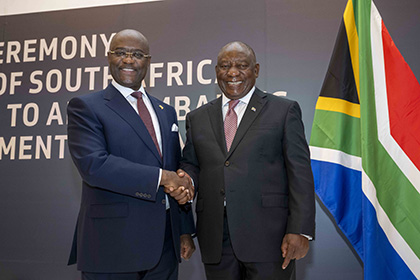
He was delivering a keynote address at the Afreximbank Accession Signing Ceremony held at the Westcliff Hotel in Johannesburg on Wednesday, 4 February 2026.
“Today, we mark a major milestone in our quest to realise the economic integration of our continent. South Africa’s accession to the Africa Export-Import Bank affirms our commitment to African industrial development and to deepening trade, investment and development across the continent,” the President said.
The signing ceremony marked South Africa’s formal transition to Class A Shareholder status in Afreximbank and the activation of a strategic partnership aimed at advancing industrial development, export-led growth and deeper intra-African trade integration.
Afreximbank is a pan-African multilateral financial institution that facilitates, promotes and expands intra- and extra-African trade and plays a key role in financing Africa’s economic development and industrialisation.
Once finalised, the South Africa Afreximbank Country Programme will be operationalised through a finance package that will initially support a range of strategic projects across the trade and industrial cluster. The programme is expected to inject capital into priority industrial projects, export diversification, infrastructure development and transformation initiatives.
“Today’s signing signals a deliberate, ambitious and more impactful phase in South Africa’s economic engagement with Africa and the world. For South Africa, the decision to accede to Afreximbank represents a strategic alignment.
“We seek to contribute to an Africa that prioritises intra-continental trade, that builds its own industrial base, and that mobilises African financial institutions to support development,” the President said.
He noted that Afreximbank has, for more than 30 years, demonstrated resilience, innovation and impact through a diversified portfolio across geographies and sectors.
The partnership will strengthen South Africa’s ability to support exporters, industrial projects and regional value chains, while advancing continental development.
The President said South Africa accedes to Afreximbank at a time of both challenge and opportunity for the continent, with global economic uncertainties, climate risks and shifting trade patterns underscoring the need to build economic resilience.
“As a country, we are implementing far-reaching reforms to restore growth, improve competitiveness and expand inclusion. We are working to accelerate economic growth by implementing structural reforms, increasing infrastructure investment and through targeted industrial policy,” the President said.
He emphasised that membership alone is not the objective, saying what matters is how the partnership is translated into practical instruments that expand productive capacity, diversify exports and integrate more South Africans into regional and global value chains.
President Ramaphosa outlined South Africa’s industrialisation path as being anchored by three mutually reinforcing pillars: decarbonisation, diversification and digitisation.
He said the country was pursuing an energy transition that balances climate imperatives with developmental realities while building new industrial capabilities and creating jobs.
“That is why we are investing in renewable energy, green hydrogen, sustainable fuels, and climate-resilient infrastructure,” he said, adding that South Africa is also focused on beneficiating critical minerals for clean energy technologies, sectors where African countries hold a competitive advantage.
The President said diversifying both the export basket and the exporter base remains key to South Africa’s economic growth strategy, with a shift toward higher value and more complex exports in advanced manufacturing, green industries, critical minerals beneficiation, pharmaceuticals and the digital economy.
Through the African Continental Free Trade Area (AfCFTA), he said, South Africa is working to build African value chains that anchor production on the continent and strengthen Africa’s economic sovereignty.
Afreximbank’s instruments, including trade finance, project preparation, risk mitigation and market access support, were described as indispensable in turning this vision into reality.
President Ramaphosa highlighted the Afreximbank Inclusive Development Support Programme for South Africa, which sets aside a dedicated facility to address structural barriers that have historically excluded many South Africans from participating in trade and industrialisation.
The programme will support small and medium enterprises, black industrialists, and women- and youth-owned firms to access finance, build assets, and participate in strategic sectors.
South Africa’s accession brings the country closer to the incubation of a South African Export-Import Bank, which will be developed in collaboration with Afreximbank and build on the experience of the Export Credit Insurance Corporation.
“This is a strategic investment in our ability to compete and to support South African firms across the export lifecycle,” the President said.
In concluding, President Ramaphosa acknowledged the leadership of Afreximbank President and Chairman of the Board of Directors, Dr George Elombi, and former President of the bank, Professor Benedict Oramah, under whose leadership South Africa’s accession process was initiated. He also thanked Minister of Trade, Industry and Competition Parks Tau, for his role in advancing South Africa’s trade and industrial agenda.
“Today, as we sign this Instrument of Accession, we do so with clarity of purpose and confidence. Let this moment mark not only South Africa’s full membership of Afreximbank, but the activation of a partnership that delivers growth, transformation and opportunity for our country and for our continent,” President Ramaphosa said.
– Source: SAnews.gov.za |
|
| |
|
| |
| TOURISM A JEWEL IN SOUTH AFRICA'S CROWN |
|
| |
| President Cyril Ramaphosa says government is “determined to strengthen the regulatory and policy environment to further grow” the tourism sector. |
|
| |
|
| |
The President addressed the nation through the weekly newsletter following the Tourism Department’s announcement that South Africa welcomed some 10.48 million international visitors last year, an increase of some 17.6% compared to 2024.
It is also the highest number of arrivals on record — surpassing pre-COVID-19 numbers in a “vote of confidence in a sector that continues to show great potential for further growth”.
“An increase in international visitors is also a vote of confidence in South Africa’s brand appeal and in our reputation as a safe, reliable, value-for-money tourism destination.
“As government, we are determined to strengthen the regulatory and policy environment to further grow the sector. We are equally committed to deepening collaboration with the private sector, labour and other stakeholders to further bolster the industry,” President Ramaphosa said.
Building blocks
Last year, Cabinet endorsed the Tourism Growth Partnership Plan with initiatives aimed at improving the performance of the sector.
Tourism currently contributes nearly 9% to the South African Gross Domestic Product (GDP).
“[Initiatives] include the expansion of the Electronic Travel Authorisation system, which was successfully piloted during the G20 Summit last year, and is currently being rolled out in key tourism markets.
“We will also be strengthening the Trusted Tour Operator Scheme launched last year, which streamlines visa processes for groups whose applications are submitted by vetted tour operators. A significant number of tourists from key markets like India and China are already using group tour operators for a more structured, tailored travel experience.
“Improving connectivity is also being prioritised. We have seen an increase in direct flight routes to South Africa from key markets such as Australia and France,” he explained.
Additional tourism monitors have been deployed and a crime call centre by the private sector has been established to ensure the safety of tourists.
Furthermore, tourism infrastructure is also under improvement.
“At last year’s inaugural Tourism Infrastructure Investment Summit, eight projects worth R1 billion were launched, signalling renewed investor confidence in our tourism sector.
“Our strategic destination marketing efforts continue, as does the focus on niche markets such as halal and green tourism to attract diverse visitors,” the President noted.
Citizens are also being encouraged to “embrace the burgeoning tourism industry”.
“[The] Department of Tourism offers fully funded Mandarin language training for registered freelance and employed tourism guides to enable them to better support tourists from the growing Chinese market. We also continue to support the transformation of the industry through various support programmes.
“Retaining our reputation as a tourism destination of choice is a society-wide effort, one in which communities have a particularly important role to play.
“Every South African should be a tourism ambassador and every community a potential tourist attraction. Our country is rich in natural beauty, history and culture, with much of this potential untapped,” President Ramaphosa said.
He noted that foreign visitors contribute to the country’s foreign earnings, “support local businesses, bolster local economies and help to create and sustain jobs”.
“Working together as government, communities and tour operators, we can popularise and attract more tourists to regions and locations that don’t traditionally feature highly as destinations for tourists.
“Working together as government, industry, communities and civil society, we can realise even greater value from this jewel in our nation’s crown,” President Ramaphosa concluded.
– Source: SAnews.gov.za |
|
| |
|
| |
| PRESIDENT CALLS FOR RENEWED PUSH TO RAMP UP AFRICA’S INFRASTRUCTURE |
|
| |
 |
|
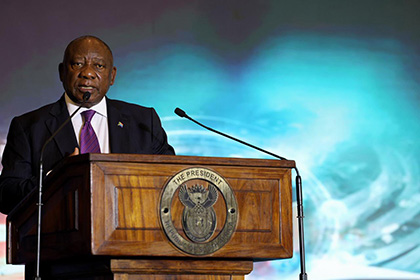
| President Cyril Ramaphosa has called for renewed political commitment, stronger institutional support and sustainable financing to fast-track Africa’s infrastructure development. |
|
|
| |
Addressing the Presidential Infrastructure Champion Initiative (PICI) Heads of State and Government Meeting on Friday at the Union Buildings in Tshwane, the President said strategic infrastructure remains central to Africa’s transformation, trade integration and long-term economic growth.
“Africa stands at a pivotal moment in its development journey. Through the Presidential Infrastructure Champion Initiative, we are charting a course to accelerate the continent’s transformation by placing strategic infrastructure at the heart of our shared vision,” the President said in his closing remarks.
The meeting reviewed progress made under the PICI portfolio and reflected on joint actions required to maintain momentum, particularly ahead of the African Union (AU) Summit scheduled for mid-February 2026.
President Ramaphosa emphasised that infrastructure development goes beyond physical construction, noting that its impact must be felt at community level.
“This initiative is not simply about building roads, bridges and energy corridors. It is about connecting our people, our economies and our aspirations.
“We need to ensure that these projects translate into tangible progress for every community, every region and every citizen,” he said.
In his opening remarks, the President highlighted infrastructure as a key catalyst for inclusive growth, enabling access to markets, essential services and economic opportunities across the continent.
“Infrastructure is a catalyst for economic growth and drives inclusive development. By prioritising infrastructure development, we are laying the groundwork for long-term economic resilience and continental integration through the African Continental Free Trade Area,” he said.
Citing a joint report by the Organisation for Economic Co-operation and Development (OECD) and the AU Commission, President Ramaphosa noted that Africa could double its gross domestic product by 2040 if infrastructure investment is scaled up but warned that the funding gap remains significant.
“It is estimated that between US$130 billion and US$170 billion is required annually to close the infrastructure funding gap in Africa,” he said.
Governments account for 41% of the continent’s infrastructure spend, underscoring their role in mobilising investment alongside development partners and the private sector.
Despite fiscal constraints and geopolitical shifts, President Ramaphosa said flagship projects under the PICI have shown resilience, pointing to progress on major cross-border initiatives.
“The Trans-Sahara Highway, for example, is now more than 90% complete.
"The Algerian segment of the fibre optic link between Nigeria and Algeria is now operational,” the President said.
He also welcomed efforts to eliminate roaming charges in the East African Community and renewed political momentum around the Trans-Sahara Gas Pipeline and the Abidjan-Lagos Corridor, which has mobilised more than $15 billion in investment interest.
To sustain this progress, the President said the PICI Secretariat must evolve into a dedicated project facility capable of moving projects from concept to financial close.
“With sufficient financial capacity, we will be able to deploy high-level technical expertise, conduct rigorous feasibility studies and create investment-ready packages that meet international standards,” he said.
However, President Ramaphosa acknowledged that challenges such as financing constraints, weak coordination, limited secretariat capacity and security risks continue to slow progress.
“These are real and pressing obstacles but they are not insurmountable,” he said.
Looking ahead to the upcoming AU Summit, the President said the focus must be on securing a clear mandate to strengthen political support, institutional capacity and financing for the next generation of infrastructure projects.
“We seek a mandate that re-energises political support for the initiative, that strengthens its institutional base, and that secures the sustainable financing and partnerships necessary to deliver the next generation of transformative infrastructure,” he said.
President Ramaphosa concluded by reaffirming that Africa’s development must remain driven by African leadership.
“Let us leave this meeting not only with a report to adopt, but with a renewed conviction that Africa’s development is, and must remain, championed by Africans.
“It must be driven by our leadership, financed through our ingenuity and sustained by our shared vision for a continent that is connected in every sense.”
The PICI was born out of a proposal by South Africa in 2011 to accelerate regional infrastructure development through the political championing of projects. The initiative serves as a high-level platform to put Africa on the right track towards unlocking its potential and thus achieving the “Africa we want", as noted in Agenda 2063.
With the active involvement of 12 championing Member States, the PICI stands as solid proof of the steadfast dedication of African Heads of State and Governments towards accelerating infrastructure development through strong political support.
The PICI currently comprises 12 member countries (increased from the original eight), with the following Heads of State and Government serving as political champions: South Africa (Chair) - under President Cyril Ramaphosa, Algeria, Benin, the Republic of Congo, Côte d'Ivoire, Egypt, Kenya, Namibia, Nigeria, Rwanda, Senegal, and Sudan as the latest to request admission.
– Source: SAnews.gov.za |
|
| |
|
| |
| TECH INNOVATIONS KEY TO BUILDING CLIMATE-RESILIENT HOMES |
|
| |
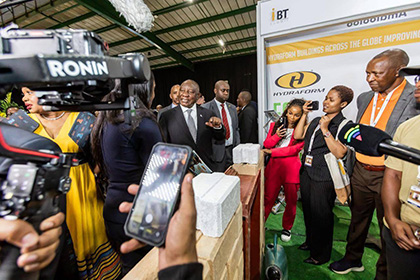
| Traditional construction methods may no longer meet the needs of a growing population facing climate change and rising urban pressures, says President Cyril Ramaphosa. |
|
| |
Speaking at the Innovative Building Technologies (IBTs) Summit in Johannesburg on Tuesday, 3 February 2026, the President said while government has provided approximately five million housing opportunities since 1994, more remains to be done as the population expands, with an estimated 2.5 million families still on the waiting list.
“In the face of this, accelerating technological housing innovations is a social imperative and an economic necessity,” he said.
President Ramaphosa noted that by 2050, nearly eight out of every 10 South Africans are expected to live in cities — many in informal settlements on land vulnerable to floods, drought, heat stress, and environmental degradation.
“If we continue to build in the old way — on the same land, with the same vulnerabilities, using the same methods — then we are not solving the housing challenge. We must make a change. We must embrace the tide of technological progress to future-proof human settlements,” he urged. |
|
|
 |
|
| |
The President cited inadequate supply, limited land availability, rising construction costs, and project delays as key contributors to housing scarcity. These pressures, he said, push prices and rents upward for the middle class, while worsening conditions for the poor, resulting in homelessness and expanding informal settlements.
“Having shelter that provides privacy, safety and freedom is inextricably bound to human dignity. Housing is not merely about shelter, but it is about belonging, security and opportunity,” President Ramaphosa said.
The summit also focused on climate-resilient housing, particularly after recent floods in Limpopo claimed at least 25 lives and caused R4 billion in infrastructure damage. The President stressed that homes must be built to “protect lives, conserve resources and endure over time”, arguing that traditional construction alone is unsustainable.
“Innovative building technologies offer us a strategic opportunity. When appropriately regulated, financed, socially accepted and locally embedded, innovative building technologies allow us to build faster and at scale. They enable us to reduce carbon emissions and water use, improve energy efficiency, and enhance durability and quality,” he said.
Building together through a social compact
A key outcome of the summit is the Social Compact, aimed at taking innovative building technologies from pilot projects into mainstream use. Through the compact, government, banks, insurers, and development finance institutions have pledged to align funding, de-risk projects, and recognise IBT housing as financeable and insurable.
“Without this alignment, innovation stalls,” President Ramaphosa said.
Concluding his address, the President framed the summit as a call to action.
“Resilience is the difference between recovery and repeated loss, between dignity and displacement, between success and failure. We have the technology to build for the present and to be prepared for the future. Now we need leadership. We need partnerships.
“We need to be creative. We need to build faster and better. Let us work together to build a resilient, inclusive South Africa which is a home to all our people, and in which all our people have a decent home.”
– Source: SAnews.gov.za |
|
| |
|
| |
| PRESIDENT RAMAPHOSA WELCOMES FIFA WORLD CUP TROPHY TO SOUTH AFRICA |
|
| |
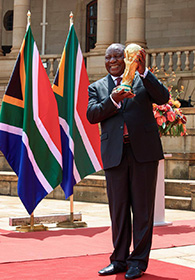
| A sense of pride, joy and quiet awe filled the Nelson Mandela Amphitheatre at the Union Buildings on Friday, 30 January 2026, as President Cyril Ramaphosa officially welcomed the FIFA World Cup Original Trophy to South Africa, marking a historic and emotional moment in the country’s football journey. |
|
| |
Bathed in sunshine and framed by the seat of government, invited guests, football legends, government leaders and members of the Bafana Bafana World Cup squad gathered in anticipation as the most coveted prize in world football was unveiled during the FIFA World Cup Trophy Tour by Coca-Cola.
The atmosphere was jubilant as the trophy, rarely seen and even more rarely touched, was revealed and handed to President Ramaphosa — one of the few individuals globally permitted to physically handle the original trophy.
“It’s really a joyful moment to be here at the Union Buildings. I'm rather glad that we brought the cup here to the Union Buildings. We have unveiled and touched it. It feels very good. It's got a nice touch and feel to it,” the President said, drawing warm applause from the audience.
The FIFA World Cup Original Trophy is the one presented to the winning team at the conclusion of the tournament, before returning to the FIFA Museum in Zurich. Outside of the tournament itself, the only time the trophy leaves Switzerland is during the FIFA World Cup Trophy Tour by Coca-Cola, the only FIFA partner authorised to activate the original trophy globally.
For South Africa, the trophy’s arrival carried meaning far beyond spectacle.
After first qualifying for the FIFA World Cup in 1998 and famously hosting the historic 2010 tournament, South Africa has now qualified again for the 2026 FIFA World Cup, ending a 16-year absence from the global stage. |
|
|
 |
|
| |
The moment symbolised not just a return but a renewal, placing the hopes, pride and aspirations of the nation firmly back into the international football conversation.
“We are going to lend it out, but it's going to come back. We'll allow it to go for a while, and then after the FIFA World Cup, the boys are going to bring it back, and we will have it here at the Union Buildings again,” President Ramaphosa said.
Addressing the Bafana Bafana squad, the President offered words of encouragement and national backing as they prepare to compete in the United States, Mexico and Canada.
“I want to applaud you and wish you well on your journey to go and do battle in the United States, Mexico and Canada, and we do have full confidence that you're going to bring the cup back. The South African public — the entire population — wishes you well, and this is the one moment when you must feel the full support of South Africans behind you.
“We are going to fill your sails with a great deal of luck, confidence and best wishes as you go out to represent the country and when you are there, just know that you are representing the 62 million people of South Africa,” the President said.
The ceremony also underscored the Union Buildings’ symbolic role as the heart of South Africa’s democracy and leadership.
“This is a beautiful, sunny day in Pretoria. This is the seat of our government, and this is where we make things happen,” President Ramaphosa said, thanking Coca-Cola for bringing the global moment home.
The event featured key photo moments with the President, FIFA World Cup-winning legend Marcel Desailly, South African football icons Siphiwe Tshabalala, members of the Bafana Bafana World Cup squad, government leadership and Coca-Cola system executives, capturing a rare convergence of sport, State and history.
The FIFA World Cup Trophy Tour by Coca-Cola in South Africa is more than a tour: it is a homecoming for South Africa, marking the symbolic beginning of the country’s return to the world’s biggest sporting stage.
As the trophy was carefully returned to its case and the ceremony drew to a close, one message resonated clearly — South Africa’s football story is once again being written, and the journey to the 2026 FIFA World Cup has officially begun.
– Source: SAnews.gov.za |
|
| |
|
| |
| DEPUTY MINISTER BOTES CONCLUDES SUCCESSFUL WORKING VISIT TO PANAMA |
|
| |
 |
|
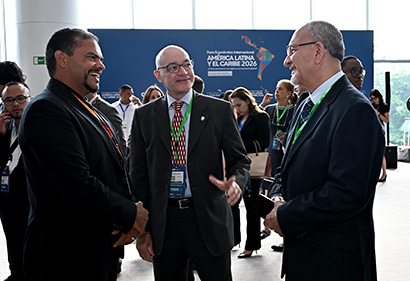
| Deputy Minister Botes has concluded a successful working visit to Panama, where he participated in the International Economic Forum Latin America and the Caribbean 2026, held in Panama City from 28 to 29 January 2026. |
| |
|
|
|
| |
Discussions at the forum focused on strengthening public-private cooperation and promoting sustainable investment. During the visit, Deputy Minister Botes met with Panama’s Vice Foreign Minister Carlos Hoyos to discuss enhancing bilateral and economic relations between South Africa and Panama.
Deputy Minister Botes also took part in a high-level panel discussion titled South-South Connection: CELAC-Africa Alliances towards a New Global Leadership. The panel brought together leaders from Latin America, the Caribbean and Africa to explore practical approaches to deepening South-South cooperation in a rapidly changing global landscape.
Discussions highlighted shared challenges such as reliance on primary exports, productivity gaps, inequality, and environmental and food security pressures. The dialogue emphasised the importance of strategic partnerships in areas including economic diversification, digital transformation, human development and the green transition, while recognising the role of the African diaspora in strengthening bi-regional collaboration.
The panel featured distinguished speakers, including former Costa Rican Vice President Epsy Campbell; Afreximbank Regional Director Okechukwu Ihejirika; Caribbean Development Bank President Daniel Best; and CAF Diversity Director Eddy Bermúdez, with moderation by Ms Lorena Arroyo of El País.
– Source: Public Diplomacy Platforms |
|
| |
|
| |
| SOUTH AFRICA TARGETS TOURISM GROWTH THROUGH INVESTMENT, CONNECTIVITY AND VISA REFORMS |
|
| |
 |
|
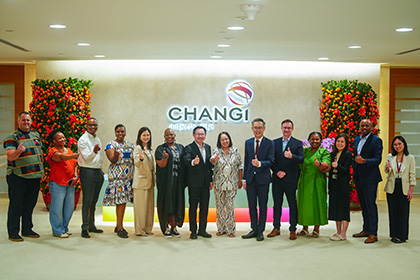
| Tourism Minister Patricia de Lille says South Africa is strengthening its tourism growth strategy through investment promotion, improved air connectivity and visa reforms, as the country deepens engagement with key Asian markets. |
|
|
| |
Minister de Lille was speaking in Singapore this week during a visit that included engagements with the Singapore Tourism Board, Singapore’s Minister of National Development Alvin Tan, and tourism sector stakeholders.
She said discussions focused on increasing tourist arrivals from Singapore and the broader South-East Asian region, as well as presenting bankable tourism investment projects in South Africa.
In 2025, South Africa welcomed 9 827 Singaporeans in the country, which is a 4.7% increase compared to the previous year.
“Thank you for contributing to South Africa’s record-breaking 10.48 million international arrivals that we recorded between January and December 2025,” Minister de Lille told the Singapore Tourism Board.
“Last year, we had our first Tourism Infrastructure Investment Summit and we are now building up to the second instalment this year in September. Our message is: Tourism Policy is Economic Policy and South Africa’s tourism sector is open for business.”
Minister de Lille said while Singaporeans who travel to South Africa enjoy hospitality and wildlife, there is more to offer.
“To improve ease of access, South Africa’s Home Affairs Department is rolling out the Electronic Visa Authorisation system. This is a game changer. Applicants can apply for a visa on their phones or computers without visiting an office. The application is processed within 24 hours. There is no human adjudication.”
Minister de Lille said while Singaporeans do not require a visa to travel to South Africa, passport holders from Indonesia, India, China, and Mexico will benefit from the efficiency of the system.
“We are also looking at how we can increase the frequency of flights to South Africa. Singapore, as a central connectivity hub in South-East Asia, is key for us to increase travellers to South Africa.
“Currently, Singapore Airlines SQ has 12 flights per week to South Africa, and we would like to see more flights from the region. And here we have made great progress, in collaboration with the private sector and law enforcement.
“The private sector has invested in the SECURA app, with panic buttons that give visitors access to emergency services,” the Minister said.
Minister De Lille told the meeting that the Department of Tourism invested R174.5 million to deploy over 2 300 Tourism Monitors at key tourist attractions across the country.
“Following the successful hosting of the G20 Summit in South Africa, next year we will host the Special Davos World Economic Forum meeting. Our world-class MICE infrastructure is being lauded globally, and that is what we’ll continue to promote,” the minister said.
– Source: SAnews.gov.za |
|
| |
|
| |
| GROOTVLEI CLIMATE SMART HORTICULTURE CENTRE LAUNCHED |
|
| |
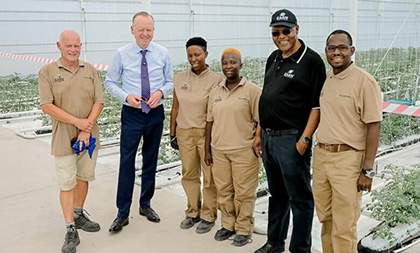
| Eskom, together with the Government of the Netherlands and the Mpumalanga provincial government, has officially launched the Grootvlei Climate Smart Horticulture Centre at the Grootvlei Power Station. |
|
|
 |
|
| |
The move marks a milestone in linking the country’s Just Energy Transition to “new local economic opportunities in climate-smart food production and skills development”.
“The project is already delivering tangible outcomes. Eight community members from the Dipaleseng Municipality are currently being trained as greenhouse facilitators.
“Additionally, 75 agripreneurs, who are also community members, will participate in the Agripreneur Development Programme, commencing in April 2026. Each agripreneur is expected to employ members from the community, and taken together, the programme is projected to support the creation of substantial sustainable jobs by 2030,” a joint statement said.
The centre serves as one of Eskom’s pilot initiatives under its Just Energy Transition (JET) Programme.
“[It is] demonstrating how repurposed energy-related infrastructure can support future-orientated economic activity beyond the energy sector.
“The focus is on practical training, skills development, and value-chain development in climate-smart horticulture rather than large-scale commercial production at this stage,” Eskom stated.
Eskom Board Chairperson, Mteto Nyati, described the project as an exciting example of partnerships bearing success.
“This project is an exciting early example of key stakeholders coming together to develop new economic activities that protect livelihoods and the local community as South Africa moves from a high-carbon to a lower-carbon economy.
“We are grateful for the leadership by the Minister of Electricity and Energy as the primary convener of JET, the significant investment by the Government of the Netherlands and its partners and the support of the Mpumalanga Premier and the Dipaleseng Local Municipality,” Mteto said.
The future development of the centre remains a priority.
“Looking ahead, the Grootvlei Climate Smart Horticulture Centre is intended to inform the development of a broader agri-economic hub, integrating agriculture, skills development and logistics, with increasing private-sector participation.
“The Grootvlei project reinforces that South Africa’s energy transition is not only about changing power sources, but about creating new economic futures for people, land and local communities,” Eskom said.
– Source: SAnews.gov.za |
|
| |
|
| |
| GARDEN ROUTE PROJECT WINS STARTUP AWARD DURING WORLD ECONOMIC FORUM |
|
| |
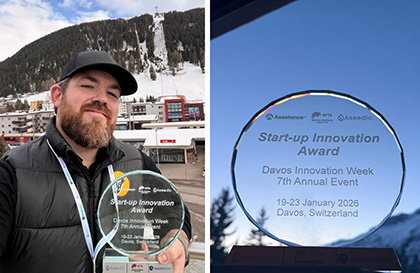
| Project ZOA (Zoological Open Architecture) has earned the Startup Innovation Award for Top AI Sustainability Project at Davos Innovation Week during the World Economic Forum. |
|
| |
 |
|
Founded in the Garden Route and presented in Davos by founder Douglas Eriksen, the project is built around the fact that artificial intelligence (AI) is increasingly used to guide decisions about land use, infrastructure, finance, and development, yet it often doesn’t include reliable environmental information.
“We are living through an unprecedented era of technological change,” shares Eriksen. “Artificial intelligence is reshaping how decisions are made. But when those systems do not understand nature, the consequences can be serious.”
Project ZOA aims to change that by turning real, verified observations of wildlife and ecosystems into structured data that AI systems can understand, compare and use. Essentially, it helps AI factor biodiversity into decision-making. |
|
|
| |
“We’re transforming biodiversity monitoring from analogue field notes into machine-readable intelligence. This creates the baseline measurements we’ll need to track ecological change in an AI-transformed world,” shares Eriksen.
The initiative is a partnership between technology company Zindalo, Wits Enterprise – the research commercialisation arm of the University of the Witwatersrand – and Cango Wildlife.
Erikson is the CEO of Cango, which focuses on endangered species conservation and the practical application of technology in conservation work.
“Cango Wildlife focuses on endangered species conservation and the practical application of technology in conservation work. It serves as the zoological infrastructure anchor for Project ZOA’s data collection and verification systems,” shares Cango Wildlife.
The project was presented to a panel of global policymakers and technology investors at the largest World Economic Forum gathering to date.
By giving AI access to accurate, real-world biodiversity data, Project ZOA can help protect sensitive ecosystems and support more informed development decisions. It puts South African conservation efforts on a global stage and shows how technology can be used to support nature, not overlook it.
– Source: www.goodthingsguy.com |
|
| |
|
| |
| SOUTH AFRICAN PHOTOGRAPHER WINS GRANT FOR POWERFUL STORYTELLING PROJECT |
|
| |
 |
|
| For a second run in three years, a female South African documentary and portrait photographer has become one of only five Global Grant winners of the international Fujifilm GFX Challenge Grant Program 2025. |
| |
Lee-Ann Olwage has received the US$10,000 (R158,900) grant to bring her latest project, Weaving Stars and Palm Leaves, to life. Along with the grant, she also receives Fujifilm gear for the duration of the project.
“With this grant I will work on a very special project that has been two years in the making called Weaving Stars and Palm Leaves. I am excited to shoot with the Fujifilm GFX System over the course of the next year to explore the rich capabilities of large-format storytelling.” says Olwage. |
|
|
| |
The story she’s set to tell is meaningful. Olwage’s work will take her to the Atlas Mountains in Morocco, where she’ll document the lives of the Amazigh women – guardians of a rug-making tradition passed down for generations.
“The Amazigh women create more than just rugs; they weave the very essence of their identity, their connection to nature and their spiritual journeys. Weavers draw inspiration from the landscapes, incorporating symbolic designs that reflect their connection to the land and spirit world.”
The project also looks closely at climate change and its impact on mountain communities, and how traditional knowledge offers insight into sustainable living.
“Due to elevation-dependent warming, mountain regions experience more rapid and intense change than lower elevation regions. In the face of climate change, the continuation of the rug-making tradition becomes even more crucial. This is because the weavers’ knowledge of natural materials and dyes, their understanding of the land, and their connection to the rhythms of nature provide valuable insights into sustainable living,” Olwage says.
Amanda Maddox, one of the judges of the GFX Challenge Grant Program, highlighted why Lee-Ann’s work stood out.
“Throughout her career, Lee-Ann Olwage has demonstrated a deep commitment to documenting women’s stories from across the African continent. Her examination of Amazigh weavers in Morocco represents a continuation of such work and promises to be a sensitive, informative exploration of tradition, gender relations and environmental concerns.”
Now in its fifth year, the Fujifilm GFX Challenge Grant Program supports creatives around the world, awarding five Global Grants and ten Regional Grants annually.
Lee-Ann joins winners from Taiwan, Japan, China and the United States — and follows in the footsteps of fellow South African Jodi Windvogel, who received the Global Grant in 2023.
Weaving Stars and Palm Leaves will see Lee-Ann spend a month in Morocco capturing the lives and artistry of Amazigh women, with her final work set to be exhibited internationally.
– Source: www.goodthingsguy.com |
|
| |
|
| |
| TWO TALENTED PERFORMERS HAVE JUST CLAIMED TOP PRIZES AT UNISA’S INTERNATIONAL VOICE COMPETITION |
|
| |
| It was a big week for music at the University of South Africa (Unisa) as two women vocalists walked away with top honours at the seventh Unisa International Voice Competition. |
|
| |
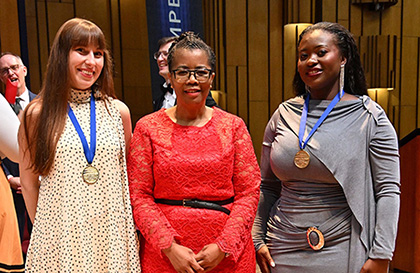
Soprano Molly Dzangare won first place in the Classical category, while jazz singer and composer Maria del Mar Vilaseca took the Jazz title, following finals held on Unisa’s Muckleneuk Campus on 30 and 31 January 2026.
“Unisa is the only African university with membership of the World Federation of International Music Competitions, and, outstandingly, the only member uniquely offering the jazz category in the federation,” says Unisa Principal and Vice-Chancellor, Prof. Puleng LenkaBula.
Over two weeks, vocalists from around the world gathered in Tshwane to compete across multiple rounds, with performances judged by a 14-member international panel. The winners were recognised for their musical maturity, interpretative insight and strong stage presence. |
|
|
 |
|
| |
Dzangare, a soprano from Zimbabwe, has already collected several awards along her musical journey, including the Schock Foundation Prize for Singing and the David Aldred Memorial Prize for Sopranos.
Vilaseca, originally from Barcelona and now based in New York, sings, composes, and plays both piano and guitar. She has performed at a range of international festivals, including the Barcelona Jazz Festival and Spain’s Festival de Jazz de San Javier.
“Over the past two weeks of intense and competitive showcasing, the finalists have proven their artistry to the juries through meeting rigorous criteria specified for each of the given rounds, and in addition, they have demonstrated their maturity and originality as artists,” shares Artistic Director of the Unisa International Music Competition, Prof. Thomas Pooley.
The Unisa International Voice Competition forms part of the broader Unisa International Music Competition, established in 1982. Alongside voice, Unisa also hosts piano, strings and wind competitions in rotating years.
– Source: www.goodthingsguy.com |
|
| |
|
| |
| TYLA MAKES GRAMMY HISTORY WITH SECOND AFRICAN MUSIC PERFORMANCE WIN |
|
| |
| Tyla’s second Grammy win marks a defining moment in her young career and signals the staying power of her global rise. She has won her second Grammy Award for Best African Music Performance at the 68th Annual Grammy Awards, held on Sunday, 1 February 2026. |
| |
The South African singer secured the win with her song PUSH 2 START, which appears on the deluxe edition of her self-titled debut album.
With this victory, Tyla becomes the first artist to win this category twice since its introduction in 2024.
The Best African Music Performance category continues to spotlight the growing global impact of music from the continent, and Tyla’s win signals the sustained reach of her sound beyond local borders.
She triumphed over a competitive group of nominees that included Burna Boy with Love, Davido featuring Omah Lay with With You, Ayra Starr featuring Wizkid with Gimme Dat and Eddy Kenzo and Mehran Matin with Hope and Love. |
|
|
 |
|
| |
Each of the nominated tracks reflected different regional styles and collaborations, underscoring the range within contemporary African music.
The award arrived shortly after Tyla celebrated her 24th birthday, adding a personal milestone to an already significant moment in her career.
Although she was not present at the pre-telecast ceremony where the award was first announced, she later appeared on the Grammy red carpet wearing a custom Dsquared2 gown.
PUSH 2 START builds on the momentum Tyla established with earlier releases from her debut project.
The song follows her breakout success with Water, which earned her the same Grammy award in 2024 and introduced her to a wider global audience.
Since then, Tyla has continued to refine her sound while maintaining clear ties to amapiano rhythms and pop structures that resonate across markets.
– Source: www.iol.co.za |
|
| |
|
| |
| SOUTH AFRICA’S CONNOR DOIG MAKES HISTORY AT AUSTRALIAN OPEN |
|
| |
 |
|
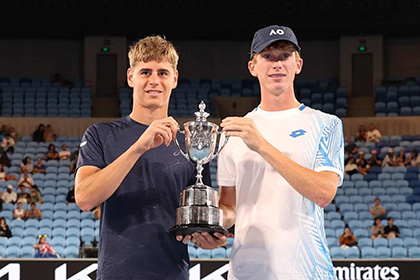
| South African tennis fans have a reason to celebrate as Connor Doig carved his name into the record books, teaming up with Bulgarian partner Dimitar Kisimov to claim the junior boys’ doubles title at the Australian Open in Melbourne, Australia. |
|
|
| |
The young duo was too strong for the Australian pairing of Ymerali Ibraimi and Cooper Kose, winning in straight sets, 6-3, 6-4. Connor’s triumph marks a historic first. He is the first South African to win the Australian Open junior boys’ doubles crown.
“We never expected to be in the final first of all. We took it one match at a time. We knew anything could happen right from the first match. We played it point by point. Anything can happen in tennis. We just kept doing what we could.”
The path to victory, however, was built on adapting.
“We made improvements after each match. When we started the tournament, we knew that we had a long way to go in terms of our understanding in doubles. We worked on who we are as tennis players and our identities on the tennis court. We worked really hard and credit to our coaches. They worked hard to make sure that we were as best prepared as possible. They made sure that we learnt after every match, and we built this up over the tournament.”
Historically, South African players have rarely lifted trophies at the Australian Open. The only man to have previously done so was Johan Kriek, who claimed back-to-back men’s singles titles in 1981 and 1982. However, Connor’s win is the first by a South African junior at the tournament, in singles or doubles.
“That feels unreal.”
Other South Africans who have reached various finals include Donald Ramphadi in Quad wheelchair doubles, Raven Klaasen in men’s doubles (2014), Lucas Sithole in Quad wheelchair singles (2014), and Wesley Whitehouse in junior boys singles (1997). And now Connor Doig joins the ranks.
– Source: www.goodthingsguy.com |
|
| |
|
| |
| SPAR PROTEAS FLIP THE SCRIPT TO BEAT ENGLAND AT ELLIS PARK |
|
| |
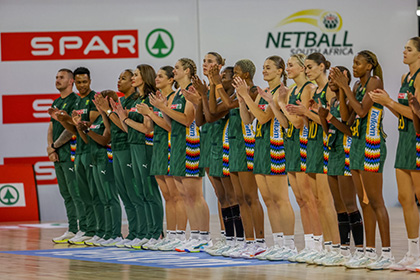
| South Africa’s SPAR Proteas delivered a statement performance at a buzzing Ellis Park on Sunday, overpowering England 65–50 to seal a 2–1 series victory in the SPAR Challenge international netball Test series. |
| |
After a tough loss the previous day, the response from the home side was immediate.
The Proteas came out firing in a high-tempo opening quarter, setting the tone early with relentless pressure and sharp execution across the court.
Everyone was talking about Sanmarie Visser (who was named Player of the Series) and goalkeeper Juanita van Tonder, who were instrumental, forcing crucial turnovers inside the circle. |
|
|
 |
|
| |
The midcourt was also clicking smoothly, and the shooters were calm and accurate, surging South Africa to a 16–9 lead by the end of the first quarter.
Coach Jenny van Dyk kept faith with her starting seven in the second stanza, and even when centre Tarle Mathe was forced off with an injury and replaced by Refiloe Nketsa, the Proteas never lost their rhythm.
In front of a near-capacity crowd treated to slick passing, spectacular intercepts and confident shooting, South Africa continued to build their advantage.
Captain Khanyisa Chawane praised the team’s response following Saturday’s defeat.
“It was amazing. I think I just liked the hunger. You could see each and every person on that court wanted to win. We went for every ball. Even if a ball was thrown in another direction, we changed our bodies. Every loose ball, we were on it. And you could tell from that effort that everyone wanted to take this. I loved the energy and from that just building to the win.”
Coach Jenny van Dyk echoed that sentiment, describing the performance as clinical and crediting the players for executing the game plan with discipline and belief.
“Today was a clinical performance and just a team that responded so well to the plan and to what we knew we had to get done out there today. So, very proud of the players and the team.”
For coach Jenny van Dyk and assistant coach Zanele Mdodana, the series achieved its broader objectives: valuable game time, testing combinations, and building depth. All that while still ending on a high with a series win.
– Source: www.goodthingsguy.com |
|
| |
|
| |
| JAYDEN SCHAPER BREAKS INTO WORLD TOP 50 AFTER BREAKTHROUGH DP WORLD TOUR RUN |
|
| |
 |
|
| After a breakthrough end to 2025, Jayden Schaper is already making waves in 2026. The South African golfer, who captured back-to-back victories on the DP World Tour late last year, has now propelled himself to a career-best 50th in the world rankings. |
|
|
| |
Schaper’s 2025 campaign was defined by a series of consistent performances that kept him in contention week after week. He came close to converting several strong finishes before finally cementing his breakthrough at the Nedbank Golf Challenge, where a composed and mature performance earned him runner-up honours and set the stage for the victories that would follow.
The back-to-back wins were particularly memorable. He not only celebrated his first professional victory at home in South Africa, surrounded by family and friends, but immediately followed it up with another triumph in Mauritius.
“Being able to have my first win at home with my family and friends, not being too far away from home, it was just a special week.”
His remarkable form continued into early 2026, including a strong showing at the Hero Dubai Desert Classic, where he tied for fourth in the Rolex Series event, reinforcing that his game is in peak form.
With a current world ranking of 50, he’s just ten spots shy of qualifying for the Masters, a milestone he’s eager to reach as he continues building on last year’s momentum.
Looking ahead, Jayden looks to climb further in the standings and compete at the highest level.
“It’s more of the same. You want to move up in the world rankings; you want to win golf tournaments and just keep yourself in the mix more often.”
– Source: www.goodthingsguy.com |
|
| |
|
| |
| TEAM SOUTH AFRICA HEADS TO MILANO CORTINA: MEET THE WINTER OLYMPIANS! |
|
| |
| For the first time, South Africa is sending five athletes to the Winter Games. From alpine to skeleton skiing, these trailblazers are ready to make history on snow and ice in the 2026 Winter Olympic Games in Milano Cortina, Italy. |
| |
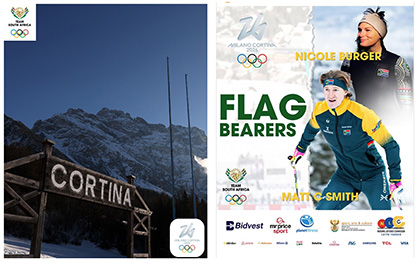
Cross-country skier Matthew Smith and skeleton athlete Nicole Burger have been given the huge honour of carrying the South African flag at the opening ceremony. At 35 and 31, respectively, they are the oldest members of the squad, but both are making their Winter Olympics debut at the senior level. Let’s meet the team:
Matthew Smith – Cross-Country Skiing |
|
|
 |
|
| |
Nicknamed “The Snowbok”, Matthew’s endurance and dedication have been on full display during his qualification in Trondheim, Norway. Guided by coach Ole Ensrud, Matthew will be racing against the world’s top athletes, ready to push his limits and proudly fly the Protea on the snowy tracks.
Nicole Burger – Skeleton
Stationed with the Royal Air Force in the United Kingdom, Nicole only discovered Skeleton a few years ago. Now ranked 30th in the world, she’s tackling some of the fastest tracks on Earth under the guidance of coach Rhys Thornbury, making history as South Africa’s first female skeleton representative.
Lara Markthaler – Alpine Skiing
After impressing at the 2024 Winter Youth Olympics, 18-year-old Lara is ready for her first senior Winter Games. Coached by Christian Markthaler, she brings youthful energy and precision to both Slalom and Giant Slalom events.
Thomas Weir – Alpine Skiing
At just 17, Thomas is one of two teenagers on the team. Trained by Robert Weir, Thomas is set to show off his skills on the slopes.
Malica Malherbe – Freestyle Skiing
The 21-year-old from British Columbia secured her spot after a stellar performance in Ruka, Finland. Currently ranked 80th in the world, Malica is ready to take on the demanding ski courses.
It’s South Africa’s biggest Winter Olympic squad ever, full of first-time Olympians, youthful energy, and trailblazers in their disciplines. Fans across the country can cheer them on as they take on the world stage from 6 to 22 February 2026.
At the time of writing, there isn’t an official place for South Africans to watch the Milano Cortina 2026 Winter Games. But don’t worry, because we’ll keep you updated on any South African-related news, highlights, and viewing options as soon as they become available.
– Source: www.goodthingsguy.com |
|
| |
| |
|
| |
|
|
|
|
|
|
|
|