| |
| |
|
| |
| PRESIDENT RAMAPHOSA REAFFIRMS SOUTH AFRICA’S STRATEGIC AUTONOMY AT ARMED FORCES DAY |
|
| |
 |
|
| President Cyril Ramaphosa has reaffirmed South Africa’s strategic autonomy and commitment to peace, saying the country will continue to assert its sovereignty amid rising geopolitical tensions. |
|
|
| |
Delivering the keynote address at Armed Forces Day at Thavhani Mall in Thohoyandou, Limpopo, on Saturday, 21 February 2026, the President said members of the SANDF serve in an era of great geopolitical tension.
“South Africa remains steadfast in our policy of non-alignment. We refuse to be drawn into the spheres of influence of competing global powers. We assert our strategic autonomy and sovereignty. And we conduct all our operations under strict civilian oversight and in absolute adherence to international humanitarian law,” the President said.
President Ramaphosa emphasised that the nation is called upon to adapt to new realities.
“There has been a shift on the battlefield from traditional weaponry to high-tech autonomous and unmanned systems such as drones, digital warfare and the use of artificial intelligence. These changes require a SANDF that is responsive, relevant and agile,” he said.
As Commander-in-Chief of the South African National Defence Force (SANDF), President Ramaphosa told dignitaries, military leadership and members on parade that he was honoured to address the Armed Forces Day.
“We are gathered here in the Vhembe District to honour our men and women in uniform, the patriotic soldiers, sailors, airmen and airwomen who for 32 years have stood in defence of our democracy.
“Our armed forces reflect the diversity of the South African nation, a people of different identities and varied origins, united in our shared nationhood and common purpose. We are united in advancing the values of our democratic Constitution and in safeguarding the fundamental rights of our country’s people,” the President said.
Paying homage to the legacy of those who came before, President Ramaphosa said the nation’s soldiers carry forward the courage and sacrifice of past generations.
“You are the shield that ensures our people know lasting peace, security and stability. You stand on the shoulders of giants: great warriors like King Makhado, the Lion of the North, and King Thohoyandou, whose leadership shaped our destiny, and of the soldiers who refused to betray the cause of freedom at the Battle of Mutale River. Their legacy is mirrored in the resolve of the modern SANDF,” he said.
Armed Forces Day is commemorated annually in remembrance of the 616 members of the Native Labour Corps who perished when the SS Mendi sank on 21 February 1917 during the First World War.
“It is recorded that they met their end not with cries of fear, but with a death dance of defiance and unity. The tragedy of SS Mendi reminds us of the importance of unity and solidarity, that despite great peril, those brave soldiers stood together as they faced their fate. Their courage and spirit continue to inspire us today,” the President said.
He paid tribute to fallen soldiers and expressed condolences to their families, saying that Armed Forces Day honours all the soldiers who paid the ultimate sacrifice while serving the Republic outside of its borders and in internal operations.
“This day is a tribute to the courage of those who wear uniform, and we bow our heads in memory of those who never returned from the horizon. We extend our deepest sympathies to the families and comrades of those who made the ultimate sacrifice,” he said.
The President also acknowledged the SANDF’s role in disaster response following heavy rains and flooding in Limpopo, Mpumalanga and neighbouring Mozambique.
“The SANDF brought its expertise to assist in the relief efforts, working together with local and provincial authorities: deploying engineers to support disaster management, repair roads and bridges, purify water and erect temporary structures for those affected. This recovery effort extended to our neighbouring country, Mozambique, where the SANDF rescued citizens from raging floodwaters,” he said.
During the Armed Forces Day programme, the South African Military Health Service rolled out Project Owethu, providing medical care, mental health services, ophthalmology, oral health and orthopaedic care in Sekhukhune, Waterberg and Vhembe districts. More than 85 cataract procedures were conducted at Elim Hospital over the past week.
Turning to public resources, the President said the country’s military was having to adapt at a time when public resources were constrained.
“Given the critical importance of the SANDF to our security, sovereignty and development, additional resources have been allocated from the budget.
“This is a targeted intervention to close funding gaps, improve efficiencies and ensure our operational ambitions are matched by our resources,” he said.
President Ramaphosa further announced a phased withdrawal of South African troops from the United Nations Stabilisation Mission in the Democratic Republic of the Congo (MONUSCO).
“Having assessed our current priorities, I have decided to draw down our participation as a troop-contributing nation in the United Nations Stabilisation Mission in the Democratic Republic of the Congo, known as MONUSCO.
“This will be done in a phased and well-orchestrated manner to ensure the safe return of our troops and their equipment. As we withdraw, we pledge our continued support to continental peace and security initiatives under the UN, the African Union and SADC,” he said.
On the domestic front, the President confirmed he had authorised the deployment of SANDF elements to support the South African Police Service in tackling crime.
“I have authorised the deployment of SANDF elements to support the South African Police Service in a targeted offensive against brazen criminality, illegal mining and ruthless gangs.
“From the Cape Flats to Gauteng, our message is clear: the rule of law will be enforced and the safety of our citizens will be secured. This deployment is a shield for the vulnerable, so that a child in Nyanga, Eldorado Park or New Brighton can walk to school without the shadow of a bullet haunting their steps,” he said.
The President called on young people to consider careers in the defence force.
“To the young people present here today and watching across the country, I invite you to see the SANDF as a career and as a calling.
“We need your capabilities in engineering, medicine, technology, strategy and many other disciplines. Join the SANDF for the love of your country. By serving your people, you build your own future, and you contribute to a better nation,” President Ramaphosa said.
The Armed Forces Day commemoration featured a wreath-laying ceremony, a fly-past by the South African Air Force and live military capability demonstrations aimed at deepening public understanding of the SANDF’s role in safeguarding the nation.
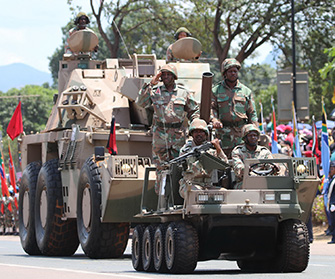
The President stood in salute as various divisions of the SANDF paraded past, observing military vehicles, advanced weaponry and specialised units on display in a show of operational readiness.
– Source: SAnews.gov.za |
|
| |
|
| |
| ENERGY TRANSITION A MATTER OF SURVIVAL - PRESIDENT RAMAPHOSA |
|
| |
| The climate transition is not only a developmental goal for South Africa but a matter of survival for humanity and the globe. |
|
| |
This is according to President Cyril Ramaphosa, who chaired the virtual inaugural meeting of the newly elected Presidential Climate Commission on Friday, 20 February 2026.
“Climate change is an existential threat to the future of humanity and the planet. We must act with others across the globe to ensure that we do not breach the 1.5 degree warming above pre-industrial levels.
“We must reduce carbon emissions at a pace and scale that is appropriate to our national circumstances. We must simultaneously climate-proof our development and infrastructure while strengthening resilience and disaster management capabilities,” the President urged.
He noted that South Africa is already “experiencing the effects of climate change”, citing flooding in parts of the country as examples of the destruction of climate change. |
|
|
 |
|
| |
“[These] are predicted to increase rapidly as we approach the end of this decade and beyond. This could significantly impede our growth and our collective prosperity. It is likely to undermine our efforts to address inequality, poverty and unemployment.
“Addressing climate change must therefore go hand in hand with improving living conditions for all. Those most vulnerable to climate change, including women, children, people with disabilities, the poor and the unemployed, need to be protected,” he emphasised.
Jobs and livelihoods of those working in carbon-intensive industries will also need to be protected as South Africa moves towards lowering its carbon emissions.
“As the country works to reduce its carbon footprint, we must ensure that this shift does not disproportionately affect the most vulnerable, such as those who depend on industries like coal mining for their livelihoods.
“This will require inclusive social dialogue and unprecedented levels of cooperation between government, business, labour and communities.
“By bringing together voices from all sectors of society, the PCC will promote consensus on the implementation of economic, social and environmental policies needed to achieve our decarbonisation targets,” he said.
From word to action
The President reflected on the progress made since the PCC’s inception in December 2020, noting that this marked a “turning point in South Africa’s climate agenda”.
Additionally, the commission has served as a platform for consensus building as the country continues its transition.
“By bringing together government, business, labour, civil society, youth and academia, the PCC has fostered inclusive dialogue and solutions to some of the country’s most complex and contested climate and development challenges.
“It has helped to align diverse interests around common goals such as the phase-down of coal, investment in renewables and the protection of livelihoods.
“It has sought to ensure that policy decisions are both evidence-based and also socially legitimate and widely supported,” President Ramaphosa said.
With the policy groundwork laid, President Ramaphosa stressed that it is now time to move the Just Energy Transition Partnership “from commitment to delivery”.
“We must translate pledges into visible progress on the ground. Among other things, we need to accelerate renewable energy deployment, strengthen and expand transmission infrastructure, enable storage solutions and create space for greater private sector participation.
“We look to this commission for guidance on how to ensure that our energy transition advances energy security while reducing emissions and maximising the opportunities for our economy from a low-carbon transition,” he said.
President Ramaphosa was candid about the challenges that lie ahead, noting the need to learn from past mistakes. He highlighted the community of Komati in Mpumalanga, which has faced economic struggle following the decommissioning of its power station in 2022 without a solid recovery plan.
“As this new commission begins its work, we should not leave important tasks unfinished. For example, we need to attend to the redevelopment of the community of Komati in Mpumalanga who, in the aftermath of the decommissioning of the power station, were left with no economic recovery plan.
“We expect all government departments at all levels to continue to be cooperative, supportive and receptive to the views of the commission.
“We expect all parts of government to take the PCC’s recommendations forward and work collaboratively on awareness and social dialogue, enabling local action and adjusting policy measures where necessary,” the President said.
He emphasised that all South Africans must be empowered to participate in the country’s energy transition “not as passive beneficiaries of government services and corporate social responsibility grants, but as economic actors”.
“This must be a transition to a transformed, inclusive and more equal economy.
“I call on you as Commissioners to work in close partnership with our key Ministers and their departments to ensure that climate action is fully integrated into our national priorities, from energy and finance to trade, labour and cooperative governance.
“Through coordinated leadership and shared accountability, we can undertake climate action in a manner that advances development, protects livelihoods and unlocks new opportunities for our people,” President Ramaphosa concluded.
– Source: SAnews.gov.za |
|
| |
|
| |
| WELL WISHES OVER RAMADAN AND LENT |
|
| |
 |
|
| President Cyril Ramaphosa wished faith communities well over Lent and Ramadan on Thursday, 19 February 2026. |
| |
The periods of Lent and Ramadan have coincided this year.
“The start of the Lent period coinciding with the start of Ramadan is a rare occurrence that, at the same time, is a powerful reminder of the deep commonality of faith traditions.
“Though they are observed in different ways, both Lent and Ramadan call on those who observe towards introspection, discipline, humility, generosity, and care for society’s most vulnerable – these are values sorely needed in today’s fractured world,” President Ramaphosa said.
Lent is the Christian season of fasting starting on Ash Wednesday and culminating just before Easter.
Similarly, Ramadan is the Muslim period of fasting and community, which will end on 19 March 2026. |
|
|
| |
The President emphasised that both faiths and others are protected under South Africa’s constitution.
“Every faith has a room here, and no South African will be marginalised or persecuted for their beliefs. The claims of those who would seek to paint a different picture do not withstand scrutiny when measured against the record of our constitutional democracy.
“At this time of great spiritual significance for our Christian and Muslim brethren, I call on all South Africans to rally in solidarity and hold fast to the unity that defines us as a people,” the President said.
– Source: SAnews.gov.za |
|
| |
|
| |
| MINISTER LAMOLA ADDRESSES STRATEGIC REFLECTION WORKSHOP ON SOUTH AFRICA’S ROLE IN THE SADC |
|
| |
| The Minister of International Relations and Cooperation, Ronald Lamola, on Thursday, 26 February 2026, addressed the Strategic Reflection Workshop hosted jointly by the DIRCO and the University of South Africa (UNISA) under the theme: A renewed South African Engagement Strategy for the SADC region. |
| |
Having marked 30 years since joining the SADC, the milestone avails an opportunity to strategically reflect and critically engage on issues affecting the region, assess and review the policy postures and positions of South Africa within the context of the regional integration agenda; and consider its implications in terms of the country’s national interests relative to SADC.
The Workshop provides a platform to critically engage on wide-ranging issues, with a view to develop a renewed South African Engagement Strategy for the SADC region, in line with the vision outlined in the National Development Plan (NDP) 2030 and the priorities set out in the Medium-Term Development Plan (MTDP) 2024-2029.
– Source: www.dirco.gov.za |
|
|
 |
|
| |
|
| |
| MINISTER RONALD LAMOLA CONCLUDES WORKING VISIT TO GENEVA TO ATTEND THE 61ST SESSION OF THE HUMAN RIGHTS COUNCIL |
|
| |
 |
|
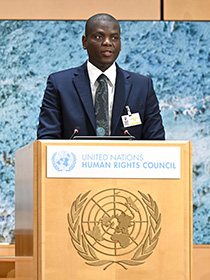
| The Minister of International Relations and Cooperation, Ronald Lamola, ended his Working Visit to Geneva when he reaffirmed South Africa’s strong commitment to nuclear disarmament, non-proliferation, and multilateralism while addressing the High-Level Segment of the Conference on Disarmament (CD). |
| |
|
|
|
|
| |
Minister Lamola congratulated the President of the Conference on assuming leadership at what he described as a critical moment for global security and assured South Africa’s full support in advancing the Conference’s work.
In his address, the Minister noted that the world is facing compounding crises characterised by the weakening of international law, erosion of multilateral institutions, and ongoing conflicts that continue to inflict immense civilian suffering. He also expressed concern about the resurgence of nuclear weapons in military doctrines, rapid modernisation of nuclear arsenals, and increasingly normalised nuclear rhetoric.
Minister Lamola highlighted the expiration of the central limits of the New START Treaty on 5 February 2026 without a successor agreement, warning that the absence of legally binding constraints on the world’s largest nuclear arsenals undermines transparency, increases global uncertainty, and heightens the risk of strategic instability and miscalculation.
He further pointed to the stark contradiction between rising global military expenditure and the persistent challenges of poverty, inequality, and underdevelopment, cautioning that this imbalance undermines both global security and the credibility of international institutions.
Looking ahead, Minister Lamola underscored the importance of upcoming multilateral disarmament milestones, including the Eleventh Review Conference of the Nuclear Non-Proliferation Treaty (NPT) and the first Review Conference of the Treaty on the Prohibition of Nuclear Weapons (TPNW), which South Africa will preside over later this year. He emphasised that these meetings must deliver concrete progress and not remain routine diplomatic engagements.
Reaffirming South Africa’s principled stance, the Minister stated that nuclear weapons do not provide security but instead pose an existential threat to humanity and the environment. He called on all nuclear-weapon states to honour their commitments and take urgent, tangible steps toward disarmament, while urging states relying on nuclear deterrence doctrines to reconsider their positions.
Minister Lamola also highlighted Africa’s commitment to remaining a nuclear-weapon-free continent and reiterated that South Africa’s voluntary dismantlement of its own nuclear arsenal remains both morally and strategically justified.
Expressing concern over the continued paralysis of the Conference on Disarmament, which has been unable to agree on a programme of work for more than three decades, he urged all delegations to demonstrate flexibility, engage in good faith, and prioritise collective global security over narrow national interests.
The Minister concluded by reaffirming South Africa’s strong support for inclusive multilateralism and its readiness to work with all delegations to break the longstanding deadlock, advance substantive negotiations, and move decisively toward a safer, more peaceful world free of nuclear weapons.
During the Working Visit, Minister Lamola participated in the following engagements:
- Delivered an intervention at the high-level panel discussion commemorating the 25th anniversary of the adoption of the Durban Declaration and Programme of Action.
- Delivered an intervention at the annual high-level panel discussion on human rights mainstreaming under the theme: The Role of New and Emerging Digital Technologies in Preventing and Eliminating Female Genital Mutilation.
- Held a bilateral meeting with the United Nations High Commissioner for Human Rights, Volker Türk.
- Held a bilateral meeting with Jeenbek Kulubaev, Minister of Foreign Affairs of the Kyrgyz Republic (Kyrgyzstan).
- Held a bilateral meeting with Bruno Rodríguez Parrilla, Minister of Foreign Affairs of the Republic of Cuba.
- Held a bilateral meeting with Espen Barth Eide, Minister of Foreign Affairs of the Kingdom of Norway.
- Held a bilateral meeting with Varsen Aghabekian, Minister of Foreign Affairs and Expatriates of the State of Palestine.
– Source: www.dirco.gov.za |
|
| |
|
| |
| DEPUTY MINISTER BOTES LEADS OUTREACH EVENT IN CAPE TOWN |
|
| |
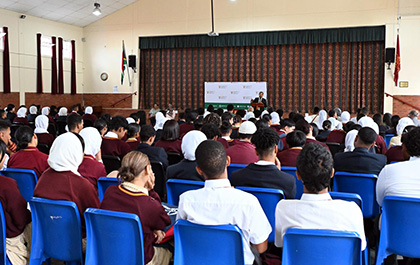
| The Deputy Minister of International Relations and Cooperation, Alvin Botes, led an Outreach Programme at South Peninsula High School in Cape Town on Wednesday, 25 February 2026. |
| |
|
|
|
 |
|
| |
The event formed part of Department of International Relations and Cooperation (DIRCO)’s nationwide Public Participation Programme, which recognises the strong link between foreign policy and domestic priorities. The programme also highlighted that South Africa’s success in global political and economic affairs depends on its ability to develop an educated and skilled workforce.
– Source: www.dirco.gov.za |
|
| |
|
| |
| DEPUTY MINISTER ALVIN BOTES HOSTS CANADA-AFRICA PARLIAMENTARY DELEGATION |
|
| |
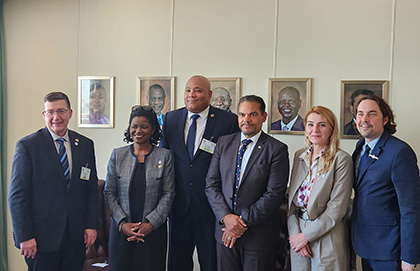
| The Deputy Minister of International Relations and Cooperation, Alvin Botes, met with the delegation from the Canada-Africa Parliamentary Association on Thursday, 19 February 2026. |
|
|
 |
|
| |
South Africa and Canada established bilateral relations in 1939, and both countries stand at a pivotal moment in their bilateral relationship, a clear turning point to build a strategic partnership of a special type.
Canada is a federal, constitutional democracy with King Charles III as the head of state, represented by Governor General Mary Simon.
The delegation was led by the Honourable Amina Gerba, a pioneer in Quebec manufacturing and distribution of body and hair care products made from natural and organic ingredients sourced through fair trade in #Africa.
Furthermore, on the margins of the 2025 G20 Leaders’ Summit, the leaders announced the launch of discussions for a South Africa-Canada Foreign Investment Promotion and Protection Agreement, to create a more predictable environment for two-way investment.
– Source: Public Diplomacy Platforms |
|
| |
|
| |
| SOUTH AFRICA TO ENGAGE GLOBAL LEADERS ON AGRARIAN REFORM |
|
| |
 |
|
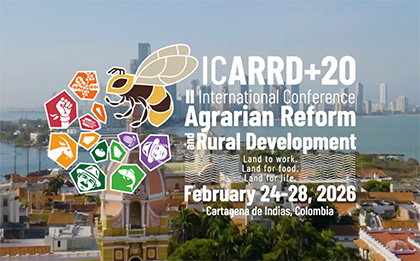
| Land Reform and Rural Development Minister Mzwanele Nyhontso will lead a high-level South African delegation to Cartagena, Colombia, for the International Conference on Agrarian Reform and Rural Development (ICARRD+20) this week. |
|
|
| |
The ICARRD+20 conference marks 20 years since the inaugural International Conference on Agrarian Reform and Rural Development, held in Porto Alegre, Brazil, and convenes at a time of renewed global focus on agrarian reform, food sovereignty and the democratic governance of natural resources.
The summit, taking place from 24 to 28 February 2026, provides a strategic platform for governments, social movements and international organisations to deliberate on pressing global challenges, including land and water grabbing, climate change vulnerabilities, and the need for redistributive land reform.
Nyhontso is expected to participate in several high-level bilateral engagements during the conference. These include consultations with the Food and Agriculture Organisation (FAO) on the launch of the Global Land Observatory and strengthened collaboration on rural development initiatives.
The Minister is also scheduled to meet with international leaders, including representatives from Brazil and other countries facing similar land reform and agrarian justice challenges, to exchange perspectives on land governance, environmental sustainability and climate justice.
In addition, the Minister will take part in ministerial sessions focusing on the balance and perspectives of agrarian reform and its role in fostering peace, democracy and equitable development.
The South African delegation comprises members of the Parliamentary Portfolio Committee on Land Reform and Rural Development, as well as senior officials from the department.
The delegation will participate in a series of key plenaries and high-level segments, including the Inaugural Plenary: Earth: Past, Present and Future: The Struggle of the Peoples for Agrarian Reform.
- Thematic Sessions: Discussions on the geopolitics of resources, including control over land, oil, and minerals.
- Global Commitments: The 10 years for Agrarian Reform plenary, aimed at securing global commitments for structural transformation.
“The Minister and the Department of Land Reform views this conference as an essential entry point for the African preparatory process, ensuring that the continent's priorities regarding land governance and dignified livelihoods are central to the global agenda,” the department said.
– Source: SAnews.gov.za |
|
| |
|
| |
| SOUTH AFRICAN STONE FRUIT ENTERS CHINESE MARKET IN HISTORIC FIRST SHIPMENT |
|
| |
| South Africa is marking a significant milestone in agricultural trade, with the country’s first consignment of stone fruit having departed for China. |
|
| |
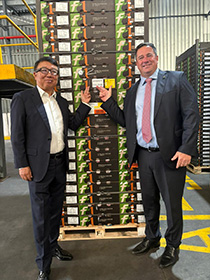
Agriculture Minister John Steenhuisen, accompanied by the People’s Republic of China Ambassador to South Africa, Wu Peng, visited the Freshness First Packhouse in Franschhoek last week, where the inaugural shipment was prepared for export.
The consignment comprises approximately 20 000 cartons of premium plums, primarily the African Delight and Ruby Star varieties. This shipment marks the official commencement of the stone fruit trade protocol, a move set to transform the local deciduous fruit industry.
Speaking at the event, Minister Steenhuisen highlighted that the opening of this Chinese market is no longer just an aspiration but a fundamental necessity for South Africa’s economic growth.
“Today, the Chinese market is a strategic necessity, not merely an opportunity for South Africa’s agricultural resilience. This is a milestone that Ambassador Peng and I have worked toward together, and today I am happy that we have realised it,” the Minister said.
The export follows the signing of a bilateral trade agreement granting South African produce 0% tariff access to the Chinese market, significantly enhancing the global competitiveness of local growers.
Diversification and economic growth |
|
|
 |
|
| |
China imports approximately US$200 billion worth of agricultural products annually. South Africa currently holds a modest 0.4% market share.
Minister Steenhuisen said the country aims to drastically expand its footprint, with plans to double the current R400 million export value over the next four years.
“South Africa does have the capacity to provide the quality and quantity of fruit that consumers in China will enjoy. The implementation of this stone fruit protocol will offset the immediate impact of tariffs imposed by other trading partners, particularly on plums. I am confident that our volumes into the Chinese market are going to increase tremendously,” the Minister said.
Expansion to cherries and blueberries
The plum shipment is the first phase of a broader expansion strategy.
Minister Steenhuisen confirmed that government is in the final stages of concluding a trade protocol for cherries, with a blueberries protocol expected later this year.
He commended industry leaders, growers and packhouse staff for their tireless efforts in meeting the rigorous phytosanitary standards required to access the Chinese market, describing their efforts as instrumental in securing the breakthrough.
– Source: SAnews.gov.za |
|
| |
|
| |
| TUNISIA’S OLIVE OIL DIPLOMACY |
|
| |
 |
|
| As her diplomatic posting to South Africa draws to a close this year, Ambassador Karima Bardaoui leaves behind more than formal engagements and protocol meetings. She leaves a textured legacy of political dialogue, educational exchange, cultural diplomacy and economic bridge-building between Tunisia and South Africa, two nations positioned at opposite ends of the African continent yet connected by shared continental ambition. |
|
|
| |
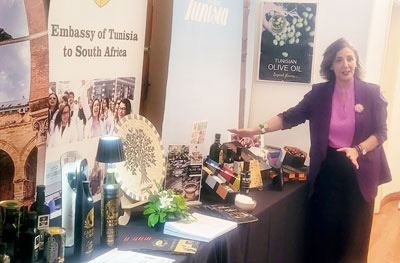
At a private and carefully curated olive oil tasting hosted at the Tunisian Embassy in Pretoria, on 20 February 2026, the Ambassador and her team offered guests not only a culinary experience, but also an invitation to understand Tunisia, a country in the far north of Africa, washed by the ancient waters of the Mediterranean, whose history and agriculture stretch back millennia.
Tunisia today stands as the world’s fourth-largest producer of olive oil. Yet statistics alone cannot convey the depth of its olive culture.
Olive trees planted more than 2 000 years ago still bear fruit across Tunisian landscapes. Families have inherited plantations and artisanal processes over generations, preserving cultivation methods that blend ancestral knowledge with modern standards. Olive oil is not merely an export commodity; it is, as Ambassador Bardaoui described, something that “runs in the veins” of the nation — Tunisia’s “Green Gold”.
The tasting table reflected the breadth of the value chain. Guests sampled olives, figs, harissa chillies, tuna, tomatoes, salads, dates and bread — each dish elevated by distinct expressions of Tunisian olive oil. Culinarily, olive oil is the soul of Tunisian cuisine. It anchors couscous, elevates salads, softens bread and gives depth and personality to dishes, said Ambassador Bardaoui.
Beyond gastronomy, olive oil in Tunisia is woven into health and wellness traditions. Frequently cold-pressed and naturally rich in antioxidants, it is scientifically recognised as one of the healthiest fats in the world.
In Tunisian households, olive oil is regarded as a first medicine and a trusted beauty secret. It is believed to protect the heart, nourish the body and, according to generations of Tunisian grandmothers, help keep one young.
This integrated ecosystem — agriculture, food processing, exports, tourism, wellness and hospitality — reveals olive oil as a cornerstone of Tunisia’s broader economic architecture.
The event in Pretoria also referenced a recent milestone in Tunisia’s diplomatic strategy. On 22 December 2025, Tunisia marked its first “Diplomacy Day for Tunisian Olive Oil” at the International Diplomatic Academy of Tunis, under the supervision of Tunisia’s President Kaïs Saïed. The initiative, led by the Ministries of Foreign Affairs, Trade and Agriculture, positioned olive oil as a vehicle of economic diplomacy, a product capable of opening markets, fostering partnerships and strengthening international visibility.
This national observance complements global recognition such as World Olive Tree Day on 26 November, proclaimed by UNESCO following a joint proposal by Tunisia and Lebanon. The olive tree, in this context, symbolises peace, resilience and shared humanity.
Ambassador Bardaoui’s tenure unfolded at a pivotal moment for Africa’s economic integration through the African Continental Free Trade Area Agreement (AfCFTA). As the continent advances toward deeper tariff reduction, harmonised standards and expanded intra-African value chains, Tunisia’s olive sector offers a compelling case study in how agricultural excellence can translate into continental opportunity.
Inter-African trade remains below its potential. Events such as the Pretoria tasting highlight the untapped possibilities between North and Southern Africa—not only in olive oil, but also in processed foods, agro-technology, tourism partnerships, logistics and investment flows.
Tunisia’s tourism and hospitality sector, deeply intertwined with its agricultural identity, presents further scope for collaboration. Culinary tourism, heritage travel and Mediterranean–African circuits can strengthen people-to-people exchange, while investment in cold-chain logistics, packaging and branding can enhance African competitiveness globally.
The limited presence of Tunisian olive oil in the South African market underlines both a challenge and an opportunity. As South African consumers grow more discerning about quality, provenance and health benefits, Tunisian producers can position themselves as premium yet authentic suppliers within an expanding African trade framework.
As guests moved between the curated dishes, they shared impressions and sought deeper insight, shaping the event into one of connection, where olive oil became a link between heritage, culture and future opportunity.
– Source: By Anisha Pemjee and Kirtan Bhana: www.thediplomaticsociety.co.za |
|
| |
|
| |
| CENTURY CITY CONFERENCE CENTRE WINS TOP ECO HONOUR |
|
| |
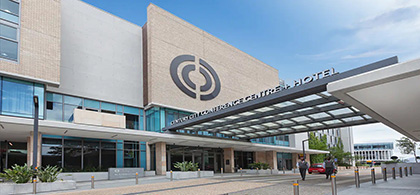
| The Century City Conference Centre has become the first venue in Africa and the Southern Hemisphere to receive the globally recognised Green Key certification, placing Cape Town on the international sustainability map for conference tourism. |
|
|
 |
|
| |
City officials say the milestone signals both environmental progress and economic opportunity, positioning the metro as a competitive destination for global events while highlighting a growing emphasis on sustainable infrastructure in the hospitality sector.
The certification, administered by the Foundation for Environmental Education and acknowledged by institutions such as the United Nations Educational, Scientific and Cultural Organisation and the United Nations Environment Programme, recognises tourism establishments that meet strict standards for environmental responsibility and operational sustainability (City of Cape Town).
At the official handover, James Vos, the City’s Mayoral Committee Member for Economic Growth, commended the venue’s achievement.
“This recognition shows that Cape Town venues are setting the green standard for practices that centre on sustainability,” he stated.
“The Century City Conference Centre has long been a champion for eco-friendly operations. In a world and city that continues to grapple with the effects of climate change, it is pivotal that all businesses and industries at large prioritise sustainability.”
The centre’s sustainability track record already included a 4-Star Green Star rating from the Green Building Council of South Africa and the title Sustainable Venue of the Year (Africa) at the Global MICE Awards in 2019.
Chief executive Gary Koetser described the accolade as validation of long-term environmental planning.
“For our team, the Green Key certificate together with a 100% audit score is a recognition of consistency and discipline. Being the first conference centre in Africa and the Southern Hemisphere to achieve this certificate matters, but what matters more is that it proves Cape Town venues can lead globally and set global benchmarks.”
The recognition comes as Cape Town continues to climb international rankings for business events. Findings from the International Congress and Convention Association GlobeWatch 2024 Business Analytics Report show the city averaged about 717 delegates per meeting, placing it among the top 10 cities worldwide for attendance.
The same report indicates international association meetings hosted locally rose from 42 in 2023 to 58 in 2024, signalling renewed growth in the sector.
Municipal planners view conference tourism as a long-term economic driver, as the City supports the Cape Town and Western Cape Convention Bureau, run by Wesgro, to attract major global events.
“Foundational to our destination development strategy is to make Cape Town the go-to city in the world for events and conferences,” Vos explained.
In the 2024/25 financial year, the bureau secured 36 conference bids, projected to generate R745 million in economic impact and draw more than 27 000 delegates through 2028.
– Source: www.capetownetc.com |
|
| |
|
| |
| PHD CANDIDATE BONTLE MASANGO TAKES AFRICAN DIABETES RESEARCH WORLDWIDE |
|
| |
 |
|
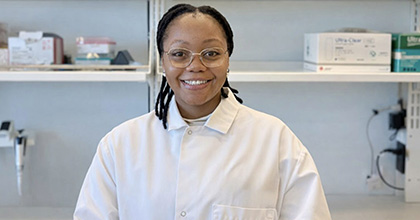
| PhD candidate at the University of Witwatersrand (Wits), Bontle Masango takes her research to the Broad Institute, aiming to tackle type 2 diabetes across Africa. |
|
|
| |
Bontle Masango is bringing her expertise in genomics to the United States as a 2025/2026 Fulbright Scholar at the Broad Institute of MIT and Harvard. Over the next five months, she will work alongside leading biomedical researchers to tackle type 2 diabetes, the most common form of diabetes in Africa, aiming to detect it earlier and reduce its serious health impacts.
Masango is a PhD candidate at Wits University’s School of Clinical Medicine. Now studying how small differences in DNA and lifestyle influence the body’s response to sugar. Her work builds on her master’s research, which examined how blood sugar levels fluctuate in South African adults after eating and how these changes relate to hormones and liver function.
Her goal is to find early warning signs of type 2 diabetes before serious complications set in.
“The purpose of my research is to find better ways to predict who is likely to develop type 2 diabetes before serious damage happens. Many people only find out they have type 2 diabetes when it has already started causing complications.”
She points out that while type 2 diabetes is widespread across Africa, it’s often overlooked.
“Because it is so common, we think of it as ‘normal’, but what many people do not realise is that diabetes increases your risk of having serious health complications like heart problems, kidney disease, eye conditions causing blindness, and foot issues that might lead to amputations.”
At the Broad Institute, she will undertake advanced training and collaborate with experts in genomics and biomedical science, contributing to research that could benefit African populations and improve precision medicine for under-represented communities. The institute’s cross-disciplinary model allows teams to tackle complex scientific questions that single laboratories cannot address, providing Bontle with an ideal environment to develop solutions that could one day reduce the burden of type 2 diabetes across the continent.
Through this programme, Masango is advancing science but also shining a spotlight on African health challenges.
– Source: www.goodthingsguy.com |
|
| |
|
| |
| BOULDERS BEACH TOPS THREE IN GLOBAL LISTS |
|
| |
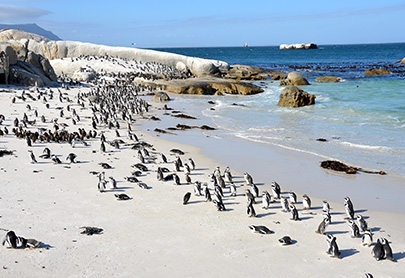
| One of South Africa’s most iconic beaches has been recognised as one of the best in the world. Boulders Beach has claimed top positions across three categories in the Travelers’ Choice Awards Best of the Best, driven by millions of traveller reviews from around the globe. |
|
|
 |
|
| |
These awards represent the highest level of excellence in travel, celebrating destinations that consistently receive outstanding reviews and opinions from the TripAdvisor community over a 12-month period. The world’s best penguin beach has 8,637 reviews, but according to the platform, fewer than 1% reach this level.
“Out of our eight million listings, fewer than 1% achieve this milestone.”
This year, the beaches category was split into two global groupings, “World” and “One of a Kind”, and then further broken down by continent. Across those lists, Boulders emerged as a clear favourite, with Camps Bay also earning recognition, reinforcing the global appeal of Cape Town’s coastline.
Here’s what the Travelers’ Choice Awards had to say about Boulders:
“Boulders has all the beachy hallmarks: clean sand for lounging, chilly pools for swimming, and boardwalks made for strolling. And then there are the African penguins (yes, penguins) that call it home. Catch them on quiet mornings before crowds roll in, and don’t miss the gift shop for kitschy souvenirs.”
In the “One of a Kind” Beaches category, Boulders claimed the number one spot in the world. It topped Pig Beach in the Bahamas, famous for its swimming pigs and social-media fame; Wai’anapanapa State Park in Hawaii, celebrated for its dramatic black sand and volcanic setting; and Isoa Bella in Italy, known for its classic Mediterranean beauty. Each of these beaches offers something memorable, but Boulders’ blend of protected wildlife, sheltered coves and unmistakable character sets it apart.
Boulders also secured the top position in the “Best African” Beaches category. In doing so, it beat destinations that regularly feature on global bucket lists, including Anse Source D’Argent in Seychelles with its granite formations and turquoise waters, Diani Beach in Kenya with its palm-lined stretches, and even Cape Town’s own Camps Bay (at number 12), loved for its sunsets and city backdrop.
In the “World’s Best” Beaches category, Boulders placed at number 10 globally, earning its spot among the very best beaches on Earth. It found itself alongside Isla Pasion in Mexico, which took the top position, Banana Beach at number six, and Paleokastritsa Beach in Greece at number 14. To be listed among destinations of that calibre speaks volumes about how Boulders is experienced by travellers from every corner of the world.
What makes this recognition especially meaningful is that it is shaped entirely by people. These awards are built on real visits, shared memories and genuine experiences, all pointing to the same conclusion: Boulders leaves a lasting impression.
– Source: www.goodthingsguy.com |
|
| |
|
| |
| DURBAN CRACKS THE WORLD’S TOP 19 TRAVEL DESTINATIONS FOR 2026 |
|
| |
 |
|
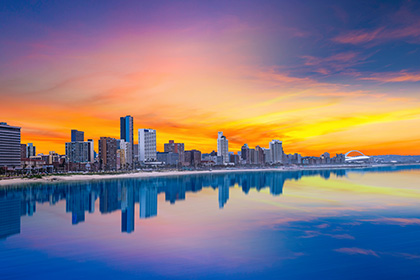
| Durban has officially been named one of the world’s best travel destinations for 2026 by “Time Out”, ranking 14th on its newly released list of The Best Places to Travel in 2026. |
| |
The global media and hospitality brand’s annual list highlights 19 destinations across the world that editors believe should be on travellers’ radar this year—from the Canadian Rockies to Hong Kong. Flying the South African flag is Durban.
Time Out South Africa’s Andrew Hallett described Durbs as the place to be for warm water, warm weather, and warm people. Nods for golden beaches, Indian Ocean swims, world-class surf breaks and the city’s famously flavour-packed food scene shaped by its rich Indian heritage. |
|
|
| |
While many international visitors default to Cape Town or the Kruger National Park, the spotlight is now shifting east. The listing also highlighted Durban’s upcoming Club Med “Beach and Safari” resort (set to open in July 2026), along with easy access to the Drakensberg Mountains, Midlands Meander art routes, wetlands, bushveld adventures and, of course, kilometres of sun-soaked coastline.
The recognition has been warmly welcomed by eThekwini Municipality. Mayor Cyril Xaba described the ranking as well deserved. He says the city has been working hard to strengthen tourism and infrastructure.
“As a city, we are pleased to receive this global recognition. This is a clear indication that Durban’s tourism sector is firmly on an upward trajectory as we work towards fully surpassing pre-COVID-19 growth levels,” he said.
During the 2025 festive season alone, Durban welcomed close to 1.2 million visitors — a 19% increase from the previous year. Accommodation occupancy rose to 77%, tourism spend jumped from R2.2 billion to R2.7 billion, and the sector’s gross domestic product contribution grew to R9.6 billion, creating over 14,000 job opportunities.
That’s not just good news for holidaymakers but meaningful for families, small businesses, hospitality workers and entrepreneurs who call Durbs home.
Time Out’s list puts Durban alongside 18 other top destinations, including Rabat, Oaxaca, Favignana, Mendoza, Nepal and Hong Kong. We love seeing a local city get its international flowers.
– Source: www.goodthingsguy.com |
|
| |
|
| |
| WORLD-RENOWNED MONTREUX JAZZ FEST LANDS IN FRANSCHHOEK |
|
| |
 |
|
| The Montreux Jazz Festival first took place almost 60 years ago in Switzerland. Since then, it has mushroomed into a music experience attracting millions of visitors at venues across the world, including Tokyo, Miami, and Rio de Janeiro. |
|
|
| |
Nina Simone, Miles Davis, David Bowie, Queen and South Africa’s own Ladysmith Black Mambazo have all performed at Montreux, and the festival carries a large archive of recordings officially recognised by the United Nations Educational, Scientific and Cultural Organisation (UNESCO).
It’s a legendary event, and now it’s Mzansi’s turn to host. A first for Africa.
Over one weekend across the town of Franschhoek, the event will combine lifestyle — art, food and wine — with jazz and multi-genre performances from more than 30 local and international artists. Some acts, including Robert Glasper with Bilal, Salif Keita, Ezra Collective, Mandisi Dyantyis, Billy Monama, Moss Mogale, Vusi Mahlasela and Ezra Collective, have already been announced, with the complete programme expected to drop in March 2026.
The event will bring international talent to South Africa and celebrate South African voices and artists.
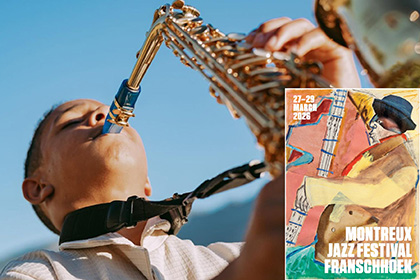
The festival’s iconic poster has shifted through the hands of visionary artists like David Bowie, Keith Haring, Andy Worhol, and Damien Hirst. South Africa’s Sam Nhlengethwa now joins them.
Nhlengethwa’s art featured on the poster represents legendary double bassist Charles Mingus, Monreux shares.
“To create this poster is a privilege. Montreux has always been a dream for musicians — now Africa joins that dream. This poster is my tribute to that connection”, shares Nhlengethwa.
Montreux’s first African event will support charities in its partnership with the Franschhoek Resource and Network Coordinating Organisation, which serves as an umbrella body for a number of different organisations supporting a variety of needs across Franschhoek’s communities. It also backs Franschhoek’s Uncorked Music Academy, whose talented young artists and students will be involved in the festival throughout the town.
– Source: www.goodthingsguy.com |
|
| |
|
| |
| MASSIVE WIN FOR PROTEAS AS THEY CRUSH INDIA AT T20 WORLD CUP |
|
| |
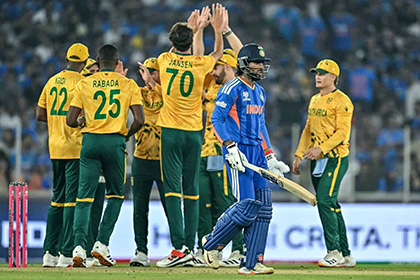
| South Africa took a big step towards the play-offs on Sunday, 22 February 2026, thumping defending champions India by 76 runs in their first match of the Super Eight stage at the T20 World Cup in Ahmedabad, India. |
|
| |
Chasing 188 runs to win, India never really got going, and the hosts were bundled out for 111 runs with seven balls remaining in their innings.
Middle-order batter Shivam Dube was the only member of India’s line-up who put up any real resistance, hitting 42 runs off 37 balls.
The Proteas’ attack was superb, combining well with seamer Marco Jansen (4/22) and spinner Keshav Maharaj (3/24) leading the charge. And though he didn’t take any wickets, Lungi Ngidi gave away just 15 runs from his four overs.
Proteas innings
Earlier, after choosing to bat, the Proteas found themselves floundering at 20/3 in the fourth over of their innings.
Their middle-order batters stood up, however, with Dewald Brevis (45 off 29), David Miller (63 off 35) and Tristan Stubbs (44 not out off 24) carrying their side to 187/7 as they kept them in the hunt.
|
|
|
 |
|
| |
Fast bowler Jasprit Bumrah was superb for India, leading their attack by taking 3/15 from his four overs with the ball, though his efforts proved futile in the end.
“It was a great performance,” Proteas captain Aiden Markram said after the match.
“It was a different type of wicket to what we have had here, but the boys assessed that early and then adapted to their plans.”
Next up, South Africa will face West Indies in a Super Eight clash in Ahmedabad on Thursday, 26 February 2026.
– Source: www.citizen.co.za |
|
| |
|
| |
| PROTEAS WOMEN HOLD OFF FIGHTING PAKISTAN TO EARN ODI SERIES VICTORY |
|
| |
 |
|
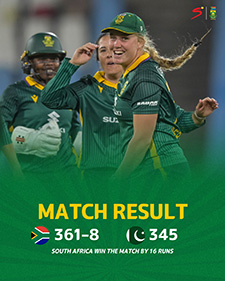
| South Africa wrapped up an impressive series victory with a match to spare on Wednesday night, hanging on against a fighting Pakistan team to secure a 16-run win in a high-scoring women’s one-day international (ODI) match in Centurion. |
| |
After winning the first game of the three-match campaign in Bloemfontein last week, the Proteas dug deep to come out on top again, taking an unassailable 2-0 series lead.
Set a target of 362 runs to win, Pakistan made a real effort, but the Proteas bowlers managed to keep the run rate down sufficiently as the pressure remained on the tourists throughout their hefty chase.
Opening batter Sadaf Shamas hit 61, and Ayesha Zafar bashed 75, while captain Fatima Sana (52 off 36) and Syeda Aroob Shah (40) made valuable contributions down the order as the visitors reached 345 before they were bowled out in the last over of their innings.
All-rounder Annerie Dercksen led the Proteas attack, taking 3/59, while fellow seamer Nadine de Klerk (2/66) and spinners Nondumiso Shangase (2/30) and Nonkululeko Mlaba (2/68) took two wickets each. |
|
|
| |
Proteas innings
Earlier, after losing the toss and being sent in to bat, three Proteas players made half-centuries, led by a destructive effort from middle-order batter Dercksen, who hit 90 runs off just 68 balls.
Tazmin Brits contributed 77 runs at the top of the order, and after the opener was stumped by Muneeba Ali off a Nashra Sandhu delivery in the 19th over, Suné Luus (57 off 67) combined with Dercksen in a 102-run partnership for the fourth wicket.
While Luus and Dercksen (who was named Player of the Match) were both eventually removed, De Klerk then added a quickfire 49 off 26 as she carried the hosts to 361/8.
It was the second-highest innings total achieved by the Proteas women in an ODI after the 375/6 they racked up against Ireland in Gqeberha in December last year.
The third and final match of the ODI series between South Africa and Pakistan will be played in Durban on Sunday, 1 March 2026.
– Source: www.citizen.co.za |
|
| |
|
| |
| CASEY JARVIS WINS MAGICAL KENYA OPEN FOR MAIDEN TITLE |
|
| |
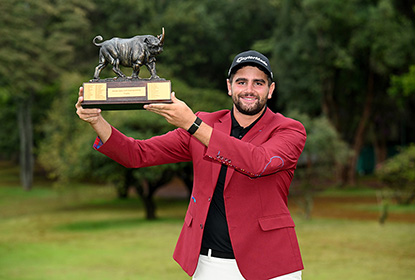
| Casey Jarvis won his maiden DP World Tour title as he rounded off a wire-to-wire success at the 2026 Magical Kenya Open presented by ABSA. |
| |
|
|
|
 |
|
| |
The South African, who had shared the lead after each of the first three rounds, held off playing partner Davis Bryant in a final round twice interrupted by stormy conditions in Nairobi.
Jarvis had six birdies and rounded off his round of 62 with a second eagle of the day to win by three strokes.
The 22-year-old said, "It's amazing; I've actually never won in front of my dad before. I've wanted to win in front of him so badly, and to finally do it when he's here, I can't explain to you the emotions.
"I was so nervous coming down the last two, so yeah, it feels great.
"There are not many words that can describe the feeling. I also wish my mum was here but she's back home in the United Kingdom. But it's unbelievable; he's been with me through the ups and through the downs.
"I know this moment doesn't happen often, so we're going to celebrate it properly tonight."
Jarvis began with three birdies and a bogey in his first four holes to reach 19 under par, still one clear of compatriot Hennie Du Plessis.
Another gain came at the sixth, with Bryant pouring in three in a row from the fifth to stay on his tail as Jarvis reached the turn one ahead. Du Plessis — after a double bogey at the seventh and birdie at the eighth — and Laporta each made two birdies early in the back nine.
Bryant coolly slotted his birdie at the 11th but Jarvis brilliantly eagled the 12th, perfectly judging his putt up the steep slope in front of the green to move two up with six to play, moments before the hooter went to bring the players in as thunder rolled. He extended his lead with a birdie on the resumption and holed a testing par putt at the next.
Laporta's par putt at the 15th somehow refused to drop, and Bryant was forced to clip out of a bush at the same hole, though an excellent recovery saved par, while Jarvis dropped a shot to cut the gap to two.
The American was back within one after a birdie at the next and another stoppage arrived with the leading pair having teed off on the 17th. Du Plessis and Jacob Skov Olesen just had time to birdie the 17th and 18th, respectively to join Laporta on 19 under.
Jarvis took dead aim at the 17th flag as play resumed again with Bryant, from the rough, finding a greenside bunker. Jarvis' successful birdie putt gave him a two-shot lead going down the last.
Du Plessis went within a foot of an albatross up ahead, the resultant tap-in eagle taking him to 21 under after a 65. Laporta and Kimsey made birdies to finish 20 and 19 under, respectively.
But that cleared the stage for Jarvis, who found the fairway and then the green in exemplary fashion before rolling in a 15-foot eagle putt to round off a momentous week in style.
Reflecting on the two suspensions, the Johannesburg native said, "There were so many thoughts going through my mind when we took the first break and I felt nervous coming back out but I just tried to stay as much in the moment as possible.
"Played solid the next four holes and then got called off again, and I was extremely nervous when we went back out the second time.
"I don’t remember the last putt but yeah, it was really good."
The celebrations can now begin in earnest, and Jarvis added, "Only a four-hour flight to Joburg – I feel sorry for the people on the plane because I feel like it’s going to be pretty loud!"
Bryant's birdie left him second outright, ahead of Du Plessis and then Laporta. Jacob Skov Olesen's 65 left him 19 under along with Kimsey, whose fellow Englishman Matthew Jordan shot 62 to vault up to seventh.
Defending champion Jacques Kruyswijk followed three straight 67s with a 65 to finish 14 under and securely in the top 20.
Meanwhile, there were rounds of 63 for Romain Langasque, 64 for Sebastian Söderberg and a bogey-free 65 to secure a six-under-par finish for Njoroge Kibugu, the smiling Kenyan sensation who thrilled the home crowd on Friday with an eagle to make the cut.
– Source: www.supersport.com |
|
| |
|
| |
| EASTERN CAPE-BORN BOXER SIMAMKELE TUTSHENI EYES WORLD GLORY IN POLAND |
|
| |
 |
|
| What started as lockdown training at Langa train station has led to a world title opportunity for one of South Africa’s fastest-rising female fighters. From the rural Eastern Cape to the bright lights of an international title bout in Poland, Simamkele Tutsheni’s rise in boxing has been nothing short of remarkable. |
|
|
| |
The 24-year-old, who now lives in Langa, Cape Town, is one of South Africa’s fastest-rising female fighters under the banner of Golden Gloves, Africa’s biggest boxing promoter. Undefeated after eight professional fights, she currently holds the International Boxing Organisation’s Africa junior champion title and is preparing for a World Championship Boxing Title fight in March 2026.
But her journey into the ring was never part of a grand plan.
“During COVID, the rugby fields were closed, so I was just running every day. I saw some guys training boxing outside at Langa train station because gyms were closed. I joined them the first day, went back the second day, and on the third day they told me to spar. After that, when the gyms opened, I said, ‘No, I want this sport.’”
Within a year of picking up the gloves, she won the Western Cape Provincial title. From there, her career gathered pace. She turned professional in 2022, at a time when there were only four female pros in the province.
“It’s not easy for girls to get opportunities. Sometimes there are tournaments with many bouts for men and maybe only one for women, sometimes none at all. We’re told we can’t get paid the same. But we pushed. With my trainers and promoters, they took me far.”
Her confidence, however, has never wavered.
“From my first fight, I knew I could go far. I won by knockout in Kimberley. The second fight was also a knockout. It felt like I was meant for this.”
For Simamkele, discipline has always been the foundation of her success.
“You can train every day, but if you’re not disciplined outside the gym, you’re nothing. Sometimes there’s no motivation; that's why discipline is the best thing.”
Now ranked number 18 in the world in her division, Simamkele has her sights set firmly on the top five and on making history.
“I’m excited. I’m the first lady from South Africa to go and fight for a world title. I’m grateful to represent my country, and I’m going to make them proud. I want to see our flag in the top five in my division.”
It all started with a chance encounter at a train station to a world title fight in Poland. Simamkele reminds us that greatness begins by simply showing up and staying disciplined enough to keep going.
– Source: www.goodthingsguy.com |
|
| |
|
| |
|
|
|
|
|
|
|
|