| |
| |
|
| |
| JUST ENERGY TRANSITION GATHERING PACE AND CREATING OPPORTUNITY |
|
| |
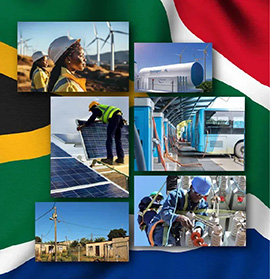
| President Cyril Ramaphosa says South Africa’s Just Energy Transition is gathering momentum, with growing investment in renewable energy creating new opportunities while the country works to secure reliable and affordable electricity. |
|
|
 |
|
| |
In his weekly newsletter, President Ramaphosa highlighted the opening of the first phase of the Ummbila Emoyeni wind farm on the Mpumalanga Highveld as a significant symbol of South Africa’s changing energy landscape.
The wind farm, situated between Bethal, Davel and Morgenzon, has been developed by Seriti Green, a subsidiary of South African mining company Seriti Resources.
The first phase comprises 25 wind turbines with a combined generation capacity of 155MW. The electricity will be wheeled through Eskom’s transmission network to supply Seriti’s coal mining operations.
According to President Ramaphosa, the project is expected to form part of a much larger 900MW hybrid energy cluster incorporating wind, solar and battery storage.
Once completed, it is expected to be the largest hybrid energy facility in South Africa.
President Ramaphosa said the development was significant because it demonstrated that the country’s clean energy investment is not being driven solely by international investors, but also by South African companies investing in the country’s energy future.
The project is also symbolic of the transformation taking place in Mpumalanga, a province whose economy and communities have for generations been closely linked to coal.
“Since the late 1800s, the coalfields of Mpumalanga have helped industrialise our country,” President Ramaphosa said, pointing to the contribution of coal miners, artisans and power station workers who have helped produce the electricity that powers South Africa’s mines, factories, businesses, hospitals, schools and homes.
He said it was therefore significant that some of the energy systems of the future were now being developed on the Mpumalanga Highveld, drawing on existing strengths and resources while incorporating renewable technologies.
Renewable energy investment accelerates
Although coal continues to dominate South Africa’s energy mix, President Ramaphosa said renewable energy generation is growing rapidly.
Citing Statistics South Africa, he noted that renewable energy accounted for just 2% of locally generated electricity in 2016. That figure increased to 6% in 2021 and reached 9% in 2024.
South Africa now has close to 16GW of installed renewable energy capacity, while another 32GW of projects are in the grid connection process and are expected to connect by 2030.
The renewable energy expansion is also evident in households and businesses, particularly through rooftop solar.
According to Statistics South Africa figures, the number of households with solar panels increased by 86% over a three-year period, reaching 675,000 households in 2025.
The President said investment in clean energy technologies had accelerated during the years of load shedding and had been supported by significant legislative and regulatory reforms.
Among these was the removal of the licensing threshold for self-generation, together with the revival of the Renewable Energy Independent Power Producer Procurement Programme. These measures helped unlock greater private investment in electricity generation.
Investment and jobs at the centre of transition
The President said attracting investment in clean energy was important not only for South Africa’s climate commitments, but also for inclusive economic growth and job creation.
At this year’s South Africa Investment Conference, more than R50 billion in green energy investment commitments were announced.
Government has also released South Africa’s first Energy Infrastructure Investment Prospectus, which provides a coordinated pipeline of investment-ready projects across the electricity value chain.
But President Ramaphosa stressed that the Just Energy Transition cannot simply be about replacing coal with renewable energy.
It must also protect communities, workers and businesses that could be affected by the transition while creating new economic opportunities.
“Going green” must, he said, ultimately contribute to lower electricity costs for consumers.
The government is therefore working towards establishing a competitive electricity market in which different operators compete to provide electricity efficiently and at the lowest possible cost.
President Ramaphosa also pointed to recent policy developments, saying Cabinet had approved the publication for public comment of the Revised Electricity Pricing Policy and the draft Electricity Sector Market Transformation Position Paper.
He further said he had received a progress report from the task team working towards the establishment of a fully independent state-owned entity responsible for electricity transmission and the operation of the electricity market.
Ensuring communities benefit
For President Ramaphosa, the transformation taking place in Mpumalanga represents more than a change in the technology used to generate electricity.
The opening of Ummbila Emoyeni and the broader expansion of renewable energy demonstrate, he said, how South Africa has responded to its energy crisis by adapting, implementing reforms and laying the foundations for a different energy future.
The challenge now is to ensure that the benefits of this transition reach the communities and workers who have historically supported the country’s energy system.
President Ramaphosa said government would need to work with business, labour and civil society to ensure that the transition is inclusive and expands economic opportunity.
The ultimate goal, he said, should be a transition that leaves communities stronger than before while delivering secure, reliable and affordable electricity for South Africans both now and in the future.
– Source: SAnews.gov.za |
|
| |
|
| |
| CONTINENT-WIDE APPROACH TO MIGRATION NEEDED |
|
| |
 |
|
| South Africa has reiterated its opposition to attempts to single it out over migration-related challenges, calling instead for a comprehensive continent-wide conference to address the root causes of migration; examine migration; improve mobility across Africa and address the challenges associated with irregular migration. |
| |
|
|
|
| |
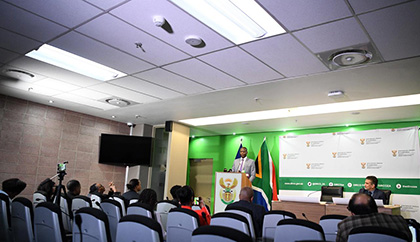
International Relations and Cooperation Minister Ronald Lamola said migration is a continental phenomenon that requires a collective, evidence-based response rather than discussions that focus solely on one country.
Briefing the media in Pretoria on Wednesday, 5 August 2026, on the outcomes of the recent 49th Ordinary Session of the African Union Executive Council, Minister Lamola said South Africa welcomed the Council's decision not to place migration on the agenda of the African Union (AU) mid-term review meeting.
Instead, South Africa continues to support the implementation of a 2015 AU decision calling for a continent-wide migration conference.
“Following a decision by the 49th Ordinary Session of the African Union's Executive Council not to discuss migration at the upcoming AU mid-term review meeting, South Africa reaffirms its support for the long-standing decision of the AU to convene a continent-wide conference on migration,” Minister Lamola said.
The Minister said the proposal adopted during the 25th AU Assembly held in Johannesburg in 2015 remains the appropriate platform to examine migration, improve mobility across Africa and address the challenges associated with irregular migration.
“The 25th AU Assembly, which was held in Johannesburg in 2015, called for an African migration conference to consider approaches to accelerate mobility and development within the continent, while addressing the challenges posed by increased irregular migration and strengthening capacity to manage migration flows. South Africa supports the implementation of this decision,” he said.
Isolation attempts
Responding to questions from journalists after the briefing, Lamola said South Africa would continue advocating for a comprehensive continental discussion on migration rather than allowing the issue to be framed as uniquely South African.
“We raised our view that any discussion on this matter must be comprehensive, dealing with the pull factors, the root causes of illegal migration, climate change, economic peace and stability, democracy in a comprehensive manner. There is no discussion that will be helpful that will just focus on South Africa, because we are not the only country facing a migration challenge.”
He said nearly 45% of Africans live outside their countries of origin, largely out of necessity rather than choice, making migration a shared continental issue.
“What we are disagreeing with is to isolate it and make it a South Africa phenomenon. If you just want to put it on an agenda and say xenophobia in South Africa, what will happen is that South Africa will be almost likely in some kind of court or inquiry where we must go there and defend ourselves. What will be the conclusion of such a meeting? It will be a zero-sum game.”
Instead, Minister Lamola said the AU should revive and implement the migration conference resolution adopted in Johannesburg in 2015.
“The African Union, in its wisdom, took a resolution in 2015 and said it calls for a comprehensive conference on migration. That is what the African Union should do. We don't have a complex task; it's already there. It's just to dust it off from the shelves and put it on the table for implementation.”
He added that South Africa would continue cooperating with the African Commission on Human and Peoples' Rights, which is expected to visit the country to engage on migration-related issues.
Holistic approach
Minister Lamola said South Africa believes migration cannot be separated from broader developmental challenges confronting the continent.
He said discussions should encompass peace and security, economic development, climate change, democratic governance, and regional integration while also addressing the drivers of anti-migrant sentiment.
“It must consider migration's relationship with peace and stability, economic development, regional integration and democratic governance.
“It must also provide space for Member States to discuss the root causes of anti-migrant sentiment and develop a collective continental approach to preventing violence, discrimination, xenophobia and other forms of intolerance,” the Minister said.
He said the urgency of such a discussion is underscored by growing migration trends across Africa.
According to research cited by the Minister, nearly six in every 10 Africans between the ages of 18 and 25 have considered emigrating in search of better opportunities. He noted that migration within Africa remains significant, with more than half of Africans living outside their home countries and choosing to settle elsewhere on the continent.
South Africa, Egypt and Côte d'Ivoire continue to receive the largest share of these intra-African migrants.
At the same time, Minister Lamola said research points to increasing negative attitudes towards migrants across Africa and globally, driven in part by economic hardship.
AU mandates
Minister Lamola also updated member states on several continental responsibilities assigned to South Africa.
The country continues to serve as Chair of the Committee of Five (C5) on South Sudan and as Chair of the Ministerial Follow-Up Committee responsible for implementing Agenda 2063.
“We appraised the AU Member States on several tasks assigned to the Republic of South Africa by the Summit and its attendant structures.”
Minister Lamola said South Africa's leadership has focused on strengthening accountability, accelerating implementation and mobilising sustainable financing for the continent's long-term development agenda.
“During our Chairship, we have noted a growing continental commitment to strengthening accountability, accelerating implementation, and mobilising sustainable financing for Africa's transformation agenda, while acknowledging the challenges that remain,” he said.
As part of this work, South Africa has recommended that the AU undertake a feasibility study into establishing an Agenda 2063 Development Fund.
“The proposed fund must complement existing African financing institutions, avoid duplication of mandates, and establish clear governance and accountability structures.”
Support for South Sudan elections
On South Sudan, Minister Lamola urged the international community to support preparations for credible and inclusive elections under the Revitalised Peace Agreement.
“With regards to the upcoming elections in South Sudan, as chair of the C5, we encourage the international community to assist South Sudan to reach the important milestone of having an election which is inclusive and realistically meets the requirements of the Revitalised Peace Agreement.
“Only a credible and inclusive election can bring long-lasting peace, security and prosperity for the people of South Sudan,” he said.
Peace and security
Minister Lamola welcomed the decision to convene an Extraordinary AU Summit on conflict prevention and resolution in Luanda, Angola, later this month.
He said the summit would provide an opportunity for African leaders to strengthen the principle of African solutions to African problems.
“South Africa welcomes the decision to convene an Extraordinary Summit of the African Union on the strengthening of mechanisms for conflict prevention and resolution in Africa from 29 to 30 August in Luanda, Angola.
“This will allow the continent to give practical expression to the principle of African solutions for African problems,” he said.
The Minister said the worsening conflict in Sudan remains one of the continent's most pressing concerns.
“The conflict in Sudan has become more than just a humanitarian catastrophe - it is one of the biggest moral failures in our lifetime.
“South Africa will use this platform as a critical opportunity to mobilise the continent towards a structured intervention,” he said.
– Source: SAnews.gov.za |
|
| |
|
| |
| SOUTH AFRICA REAFFIRMS COMMITMENT TO MIGRATION CONFERENCE |
|
| |
| South Africa has reaffirmed its support for the long-standing decision of the African Union (AU) to convene a continent-wide conference on migration, the Department of International Relations and Cooperation (DIRCO) said. |
|
|
 |
|
| |
“Following a decision by the 49th Ordinary Session of the African Union’s AU Executive Council not to discuss migration at the upcoming AU mid-term review meeting, South Africa reaffirms its support for the long-standing decision of the African Union to convene a continent-wide conference on migration,” the department said in a statement on Thursday, 30 July 2026.
The 25th African Union Assembly held in Johannesburg in 2015 called for an African migration conference to discuss, among others, approaches to accelerate mobility and development within the continent while also addressing the challenges posed by increased irregular migration and developing capacity to manage migration flows within the continent.
“South Africa supports the implementation of this decision and believes that a continent-wide convening on migration should consider migration holistically, including its relationship with peace and stability, economic development, regional integration and democratic governance.
“It should also provide space for Member States to discuss the root causes of anti-migrant sentiment and develop a collective continental approach to preventing violence, discrimination, xenophobia and other forms of intolerance,” it said.
The department added that the need for the dialogue has become increasingly urgent.
“Migration is a continental phenomenon whose consequences extend beyond the jurisdiction of any single state. The urgency is further underscored by recent research indicating that almost six in 10 Africans aged between 18 and 25 have considered emigrating, primarily in search of better opportunities.
“At the same time, African migration remains predominantly intracontinental, with most African international migrants moving to another country on the continent. Research also points to growing negative attitudes towards migrants across the continent and globally, driven in part by prevailing economic hardship.”
Although Africa has participated in discussions on migration with other regions of the world, the continent has yet to convene a comprehensive forum of its own at which Member States can collectively examine Africa’s migration challenges and opportunities.
Such a conference would provide a platform for African countries to exchange experiences, reflect on best practices, share lessons and develop cooperative responses grounded in the continent’s unique circumstances.
Minister of International Relations and Cooperation Ronald Lamola said: “Attacks on migrants of African descent, and on migrants generally, are an affront to our democracy and a betrayal of our Constitution’s promise to build a society founded on human dignity, social justice and fundamental human rights. The South African Government is seized with this matter and is coordinating efforts to ensure that those responsible for assault, intimidation, looting, robbery and other criminal acts face the full might of the law."
The department said a lasting solution to migration pressures cannot be achieved through selective approaches that single out or denigrate individual Member States.
“It requires honest dialogue about the push and pull factors driving movement in countries of origin, transit and destination, as well as the responsibilities that all states must discharge.
“South Africa remains firmly committed to Pan-Africanism and African solidarity. The collective concerns, interests and aspirations of the continent remain at the heart of South Africa’s foreign policy and identity as a democracy.”
This commitment is demonstrated through South Africa’s efforts to advance peace and stability, economic integration, pandemic preparedness and a just response to Africa’s debt burden.
“It is the path South Africa has consistently followed and will continue to tread,” the department said.
– Source: SAnews.gov.za |
|
| |
|
| |
| DEPUTY MINISTER BOTES UNDERTAKES OFFICIAL VISIT TO JAMAICA, STRENGTHENING SOUTH AFRICA-JAMAICA RELATIONS |
|
| |
 |
|
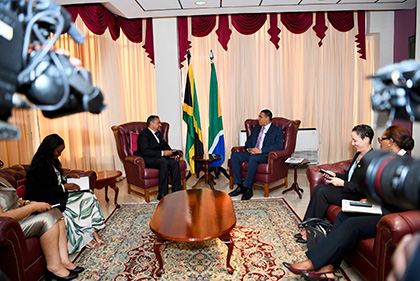
| Deputy Minister of International Relations and Cooperation, HE Alvin Botes, undertook an Official Visit to Kingston, Jamaica, where he engaged with senior members of the Jamaican Government, business leaders and academia, reaffirming the strong historical and contemporary ties between South Africa and Jamaica. |
| |
|
|
|
| |
Upon arrival in Kingston on 5 August 2026, Deputy Minister Botes was received by the Honourable Robert Morgan, Minister of Economic Growth and Infrastructure Development with responsibility for Works, alongside Ambassador Cheryl Spencer and Ambassador Franz Hall.
As part of his programme, Deputy Minister Botes paid a courtesy visit to the Prime Minister of Jamaica, Dr The Most Honourable Andrew Holness, ON, PC, MP. The engagement provided an opportunity to reaffirm the close relationship between South Africa and Jamaica and to discuss matters of mutual interest.
Deputy Minister Botes also held bilateral discussions with Senator the Honourable Kamina Johnson Smith, JP, Minister of Foreign Affairs and Foreign Trade of Jamaica. The meeting focused on strengthening bilateral cooperation and advancing shared priorities between the two countries.
Economic cooperation also featured prominently during the visit. Deputy Minister Botes delivered remarks at a private-sector ministerial luncheon hosted by Senator the Honourable Aubyn Hill, Minister of Industry, Investment and Commerce of Jamaica, at the AC Hotel in Kingston. The engagement provided an opportunity to explore opportunities for greater economic, trade and investment cooperation between South Africa and Jamaica.
Deputy Minister Botes delivered a public lecture at the University of the West Indies (UWI) in Kingston under the theme, The Path to Reparatory Justice for Africans and People of African Descent. The lecture highlighted the shared historical experiences of Africans and people of African descent and the importance of advancing the global discourse on reparatory justice.
Deputy Minister Botes’ engagements in Jamaica underscore South Africa’s commitment to strengthening relations with the Caribbean region and advancing cooperation based on shared historical experiences, solidarity and common aspirations for development, economic growth and justice.
– Source: Public Diplomacy Platforms |
|
| |
|
| |
| SADC INDUSTRIALISATION WEEK DEMONSTRATES POWER OF REGIONAL COOPERATION |
|
| |
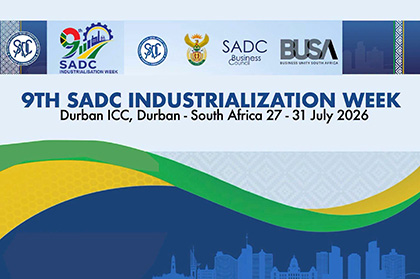
| The Ninth Southern African Development Community (SADC) Industrialisation Week has been a demonstration of the power of regional cooperation through robust discussions, practical exchanges and new partnerships. |
| |
|
|
|
 |
|
| |
This is according to the Deputy Director-General (DDG) of Trade at the Department of Trade, Industry and Competition (the dtic), Xolelwa Mlumbi-Peter, who made these remarks at the closing ceremony of the week-long SADC Industrialisation Week held at the Durban International Convention Centre (ICC).
DDG Mlumbi-Peter said the conference renewed collective commitment to advance the SADC Industrialisation Strategy and to build a region that is resilient, sustainable and inclusive.
The South African government hosted the event in partnership with the SADC Business Council and the SADC Secretariat from 27 July to 31 July 2026.
It supports the implementation of the SADC Industrialisation Strategy and Roadmap (2015 – 2063), which is anchored on three pillars: industrialisation, competitiveness and regional integration.
Hosted under the theme: Resilient, Sustainable and Inclusive Industrialisation through Infrastructure Development, Agricultural and Critical Minerals Transformation in Pursuit of a Just World, it is a high-level precursor to the 46th SADC Summit of Heads of State and Government.
Among the key declarations made at the conclusion is a commitment to promote beneficiation and local processing of critical minerals and agricultural products to maximise regional economic value, mobilise greater public and private investment in industrial infrastructure, including energy, transport, logistics, digital connectivity and industrial parks.
In addition, the meeting pledged to strengthen regional industrial value chains to increase production, value addition, intra-SADC trade and industrial competitiveness.
DDG Mlumbi-Peter emphasised that the success of the meeting will be measured by how effectively the declarations and recommendations emanating from discussions are implemented.
“We will work closely with the SADC secretariat to develop a roadmap that will help translate the outcomes into concrete actions that create jobs, expand regional value chains and improve the lives of our people.
“We must consistently be mindful of the fact that sustainable industrial development cannot be achieved by governments alone; strong partnerships between governments, the private sector, development finance institutions, academia, research institutions and development partners remain essential for mobilising investment, supporting innovation and accelerating implementation of regional industrial priorities,” she said.
The SADC Deputy Executive Secretary Angele Makombo N’tumba concurred that the ideas shared at the meeting must now be translated into practical programmes, bankable projects and measurable results.
"Our citizens will judge our success not by the quality of our discussions, but by the industries we establish, the jobs we create, the technologies we develop and the opportunities we provide for future generations.
“Industrialisation is not a competition among Member States. It is a shared regional journey where each country contributes its comparative advantage while benefiting from a larger, integrated regional market,” she said.
– Source: SAnews.gov.za |
|
| |
|
| |
| GOVERNMENT REAFFIRMS GENDER EQUALITY COMMITMENT AT PORTRAITS OF POWER EXHIBITION |
|
| |
 |
|
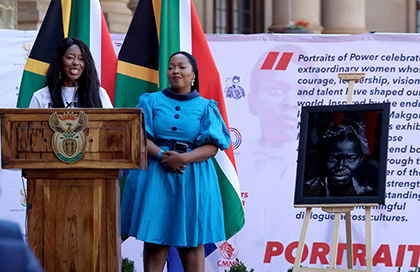
| Minister in The Presidency Khumbudzo Ntshavheni has reaffirmed government’s commitment to advancing gender equality and honouring women’s legacies at the inaugural “Portraits of Power” exhibition, which pays tribute to Charlotte Mannya-Maxeke’s enduring contribution to women’s leadership and social justice. |
|
|
| |
“In South Africa, we remain firmly committed to advancing gender equality and the empowerment of women. This commitment is rooted in our Constitution and reflected in our policies, programmes and partnerships. We recognise that inclusive leadership is not optional,” the Minister said on Tuesday, 4 August 2026, in Pretoria.
The Minister was addressing the launch of the Portraits of Power Exhibition, which celebrates extraordinary women whose courage, leadership and contributions have shaped nations and inspired generations.
The International Portraits of Power exhibition is a Charlotte Mannya-Maxeke Institute initiative presented in partnership with The Presidency of the Republic of South Africa and participating diplomatic missions.
“Portraits of Power goes beyond celebration. It is a recognition that women’s contributions transcend borders, cultures and generations. Across the globe, women are at the forefront of leadership, diplomacy, innovation and development.
“They are shaping policies, building communities and driving progress in ways that are both transformative and enduring.
“Therefore, The Presidency will continue to support this initiative and others like it, because the story of humanity is incomplete without recognising the invaluable contributions of women across all spheres of life,” Minister Ntshavheni said.
The Portraits of Power project forms part of a series of legacy projects commemorating the 155th birthday anniversary of Mannya-Maxeke.
“Charlotte Mannya-Maxeke was a woman of remarkable strength and enduring influence, and a trailblazer in every sense. As the first black woman to graduate with a university degree in Southern Africa, we tend to limit her to being the first black woman to graduate in South Africa, but she was the first black woman to graduate with a degree in Southern Africa after obtaining her Bachelor of Science degree on 20 June 1901, from Wilberforce University in the United States of America. Mannya-Maxeke led the path for women’s rights and gender equality,” the Minister said.
Minister Ntshavheni pointed out that Mannya-Maxeke was the only woman present when the South African Native National Congress, later known as the African National Congress (ANC), was formed in 1912.
“Mannya-Maxeke decisively asserted the need for women’s representation in the corridors of power in South Africa. She went on to become the founding president of two of the most important women-led institutions on the continent. Of particular importance to us is the Bantu Women’s League, which later evolved into the ANC Women’s League in the 1940s,” the Minister said.
While the government has made strides in empowering women since South Africa attained freedom, the Minister said the journey toward full equality is not yet complete.
“There remains work to be done to ensure that women everywhere in the world have equal access to opportunities, resources, platforms for leadership and education,” the Minister said.
She emphasised the importance of inclusive leadership, saying it is essential for sustainable development, social justice and lasting peace.
“We also recognise that achieving this vision requires collaboration. It requires governments, the private sector, civil society and the international community to work together to create environments where women can thrive, lead and succeed.
“Therefore, let this exhibition be more than a moment of admiration. Let it be a call to action. Let us commit to supporting and elevating the voices of women in all spaces.
“Let us invest in their potential and remove the barriers that hinder their progress. Let us strengthen global partnerships that promote equality, dignity and opportunity for all.
“In doing so, we not only honour the legacy of those who came before us, like Maxeke and the other women who are being honoured today, but we also ensure that, through this initiative and others like it, we are paving the way for the celebration of future generations of women leaders,” Minister Ntshavheni said.
– Source: SAnews.gov.za |
|
| |
|
| |
| SOUTH AFRICAN TOURISM RECORDS DOUBLE-DIGIT GROWTH |
|
| |
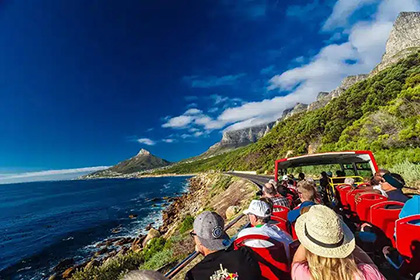
| South Africa's tourism sector continued its strong recovery in the first half of 2026, with international tourist arrivals increasing by 12.3% compared with the same period last year, according to the Department of Tourism. |
|
|
 |
|
| |
The latest tourism figures show that South Africa welcomed 5 584 473 international tourists between January and June 2026, reflecting sustained growth across both regional and overseas markets.
The increase was driven by a 14.3% rise in arrivals from the African continent, while overseas arrivals grew by 5.6%, underscoring the country's continued appeal to international travellers.
June also delivered another strong performance, with 823 365 international tourists visiting South Africa during the month, representing a 9.8% year-on-year increase. Tourist arrivals from Africa climbed by 12.1% compared with June 2025.
The United States remained South Africa's leading overseas source market for the second consecutive month in June, with 40 566 American visitors travelling to the country.
Tourism Minister Patricia de Lille attributed the positive results to government's strategy of broadening the country's tourism offering and strengthening partnerships with the industry and international markets.
"The deliberate decision to diversify our tourism products is yielding positive results. The sustained growth in both regional and overseas arrivals reflects the resilience of our tourism sector and the effectiveness of the partnerships we have built with industry and our international markets," Minister de Lille said.
She said government would continue to strengthen partnerships through joint marketing initiatives across the African continent while expanding its presence in strategic overseas markets.
Minister de Lille added that the latest figures reinforced government's commitment to improving ease of access for travellers, expanding air connectivity and positioning South Africa as a preferred destination for both leisure and business travel.
– Source: SAnews.gov.za |
|
| |
|
| |
| SOUTH AFRICAN DANCER MIETTE LOMBARD BRINGS HOME FIVE WORLD CHAMPIONSHIP GOLD MEDALS |
|
| |
 |
|
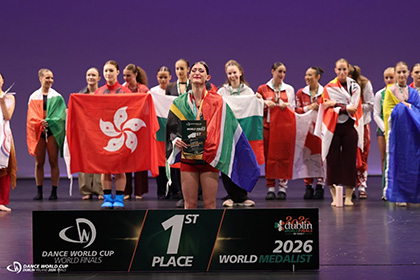
| The 17-year-old South African dancer returned from the World Dance Championships in Dublin with five gold medals and a growing dream of a professional career. |
| |
When Miette Lombard’s entry number was announced at the World Dance Championships in Dublin, the 17-year-old South African dancer could hardly believe what she was hearing. After months of preparation, she had been named a world champion.
“I remember taking a breath,” Lombard said. “Then they said, ‘Number seven from South Africa,’ and it was just this wave of relief, pride and accomplishment.” |
|
|
| |
That moment was the first of several memorable achievements for Lombard, who returned home with five gold medals after competing in 13 dance items at one of the world’s largest international dance competitions.
For Lombard, dance has been a constant in her life.
“My love for dance has kind of just always been there,” she said. “I’ve experienced burnout at certain times, but I always come back to this place of being absolutely in love with dancing and every part of it.”
Her first dance class was at the age of three, and she has continued to develop her skills ever since. While her passion for performing remains a major source of motivation, she is also driven by the knowledge that every class and performance brings her closer to her goal of becoming a professional dancer.
“Every time I step into a class, I know I’m going to improve. Every time I step onto a stage, I’m going to improve,” she said. “I’m working towards an end goal. This is my life.”
At the championships, Lombard performed five solos, two duos, two trios and four group routines. Her studio had been preparing for the competition since January last year, with regular rehearsals helping each performance become second nature.
“The brain doesn’t remember it; the body remembers it,” she explained. “It’s like building a wall out of bricks. You keep adding brick by brick.”
Lombard’s first gold medal remains particularly special. As the results were announced, she was still celebrating the achievements of her friends and teammates when her own category was called. One of her gold medals was awarded on her birthday, making the achievement even more meaningful as she celebrated alongside her teammates and family.
Lombard credits her parents for the unwavering support and sacrifices they have made throughout her journey.
While recovering from a back injury, Lombard is continuing to explore the options available to support her recovery and return to full strength.
“I’m still at the beginning of the road to recovery, but we’re looking at our options and seeing what we can do to get me back on track.”
Lombard is looking ahead to the next stage of her career. She hopes to transition from competitive dance into professional performance and use the stage to express who she is as both a dancer and a person.
“I’m really looking forward to my career and to my end goal of being a performer and being able to convey to an audience who I am as a dancer and as a person.”
– Source: www.goodthingsguy.com |
|
| |
|
| |
| JOHANNESBURG EARNS BRAGGING RIGHTS AS ONE OF THE WORLD’S BEST STREET FOOD CITIES |
|
| |
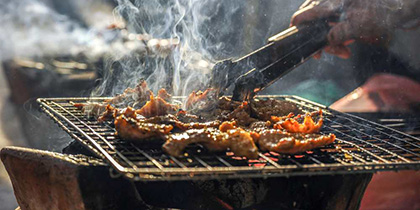
| “Time Out” has ranked Johannesburg eighth on its list of the world’s best cities for street food in 2026, putting our City of Gold in the company of global food capitals like Ho Chi Minh City, Kuala Lumpur and Mexico City. |
|
|
 |
|
| |
The ranking comes from a survey of 24 000 people around the world, who rated the quality and affordability of food in their cities.
Ho Chi Minh City claimed the top spot this year, followed by Kuala Lumpur, while Jakarta and Taipei shared third place. Johannesburg landed in eighth place with a 56% approval rating.
Jozi street food deserves its world-class ranking. A proper kota stuffed with chips, polony, cheese, atchar and sauce does not play around. Then there’s shisanyama – even just the smell of meat on the braai hits the spot. There’s also vetkoek and fluffy dombolo, mogodu, morogo, skopo, chakalaka and even maotwana for those who know just how good chicken feet can be.
And let’s not pretend the humble Friday afternoon boerie roll outside your local Spar doesn’t deserve an honourable mention.
Street food has always been one of the easiest ways to experience a city. In Johannesburg, it is a reflection of the many cultures, traditions and communities that make our rainbow city what it is.
– Source: www.goodthingsguy.com |
|
| |
|
| |
| HOW FLAMINGO ROOM BY TASHAS BECAME RIYADH’S HOME AWAY FROM HOME FOR SOUTH AFRICANS |
|
| |
 |
|
| A Sandton-born restaurant group has landed in the Saudi capital, and South African expats can’t stop talking about it. |
| |
South African hospitality travels all over the world, and Flamingo Room by tashas in Riyadh is proof. The tashas Group, born in Sandton, Johannesburg, has quietly become one of the most talked about South African exports, sitting in the middle of the Saudi capital’s dining scene.
Flamingo Room first opened in Dubai back in 2017, before the concept made its way into Saudi Arabia in 2023 with a striking Diriyah venue. It has since become a firm favourite for South African expats craving a taste of home, tucked into the historic Bujairi Terrace overlooking Wadi Hanifah. |
|
|
| |
What makes it stand out among Riyadh’s crowded dining scene is the menu itself, described as modern European meets South African. That combination is rare in the Gulf, and it explains why Saffas living and working in the Kingdom keep returning for something that genuinely reminds them of home.
A space that feels instantly familiar
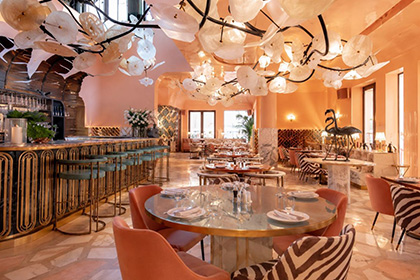
The space itself does plenty of heavy lifting. Pink walls, chic detailing and views over the Wadi Hanifah give Flamingo Room a glamorous, unmistakably tashas feel, wherever in the world you find a branch. It is the kind of restaurant South Africans recognise instantly, even four thousand kilometres from Sandton.
A menu built on nostalgia
On the menu, expect South African-inspired favourites alongside European classics. The butternut carpaccio and calamari Mozambique are firm favourites, while dessert brings the biggest wave of nostalgia. The Amira, a malva pudding with macerated apricot and spiced creme anglaise, is doing serious emotional work for homesick diners.
Holding its own in a competitive scene
Riyadh’s dining scene has exploded in recent years, with international brands opening branches across the city at speed. Yet Flamingo Room has been highly commended among the best European restaurants in Riyadh, proof that South African flavour and hospitality can hold its own against London and Dubai imports.
If you are a South African living in or visiting Riyadh, Flamingo Room by tashas at Bujairi Terrace is worth the booking, and the reservations page linked above will get you started.
– Source: www.sapeople.com |
|
| |
|
| |
| ST STITHIANS MAKES HISTORY AS FIRST SOUTH AFRICAN SCHOOL SELECTED FOR MAJOR US FILM FESTIVAL |
|
| |
 |
|
| St Stithians has just become the first South African school to earn an official selection at the world’s biggest film festival for high school filmmakers, and the boys behind the camera are now heading to New York, United States (US). |
| |
A group of young filmmakers from St Stithians College are getting ready for a moment many aspiring directors only dream about. Their film has been officially selected for the 2026 All-American High School Film Festival, making St Stithians the first South African school to reach the prestigious international event.
The achievement is even more impressive considering many members of the school’s Film Club had never even made a film before.
“Faced with uncertainty, our students embraced the opportunity with remarkable enthusiasm and commitment, driven by determination, creativity, and a shared passion for storytelling. Their hard work and resilience ultimately culminated in an extraordinary achievement,” shared the school. |
|
|
| |
The project began at the start of the second term when the club set themselves an ambitious goal to create a film and submit it to the world’s largest film festival dedicated to high school filmmakers. With more than 2500 submissions from over 40 countries, earning an official selection would not be easy.
Still, the students embraced the challenge and secured their spot. Their mockumentary, The Play (or the Failure Thereof), has been selected in the Comedy category and will be screened in New York City this October.
Directed by Grade 10 learner Landilani Chinkanda, who also co-wrote the screenplay with Grade 11 learner Shakeel Karumia, the film follows the increasingly chaotic production of a school play.
“The mockumentary follows the production of a school play as it unravels in increasingly entertaining fashion, offering both humour and insight into the creative process,” shares the school.
Adding to the weight of the achievement, the film was all student-led. The acting, cinematography, editing and production, and every other part of the project were planned and brought to life by members of the Film Club.
The festival takes place from 16 to 18 October 2026 in New York City, where The Play (or the Failure Thereof) will be screened at the historic Empire Theatre before an audience of fellow young filmmakers, film industry professionals and film lovers from around the world.
“This milestone represents not only a remarkable accomplishment for the Film Club but also a proud moment for the Boys’ College, as our students showcase their talent on a global stage. We congratulate everyone involved in bringing this project to life and wish them every success as the festival’s nominations and awards process unfolds,” the school shared.
– Source: www.goodthingsguy.com |
|
| |
|
| |
| PRETORIA BAND TAKES SOUTH AFRICA TO THE METAL WORLD CUP |
|
| |
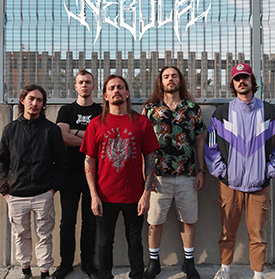
| Human Nebula is flying the South African flag high at one of the biggest metal stages in the world. Last week, the local band performed at the international Wacken Metal Battle Finals in Germany, going up against national winners from 31 countries. |
| |
The international final forms part of Wacken Open Air, one of the world’s best-known heavy metal festivals. Every band that reaches the international finals has already won its national or regional competition, making the global event in Germany a spotlight for some of the strongest emerging metal acts from around the globe.
Human Nebula earned its place after winning Wacken Metal Battle Africa 2026, securing the chance to represent both South Africa and the continent in Germany.
“Every single band that participated deserves to go. And there are bands not afforded such opportunities that also deserve to go. Therefore, we do not take this responsibility lightly and will do everything within our power to make you, South Africa and Africa, proud!” Human Nebula shared, after winning the national and regional title. |
|
|
 |
|
| |
The Pretoria-based band has been prominent in the metal scene since forming in 2018. They quickly gained attention with their debut EP, Pillars of Creation, which won Best EP at the 2019 South African Metal Music Awards.
The local band, beyond representing their country at the international battle, have used the opportunity to champion their fellow African alternative artists as well.
Before heading to Germany, they put out a call to alt bands from across Africa, asking them to submit a song for USBs that have since been handed out at the festival in Germany. In doing so, they’ve introduced more people to the growing alternative music scene on the continent and have given other artists a chance to be discovered.
Now that the performances have wrapped up, the band — and many of their South African fans — are waiting to hear the final results. Reaching the international final is a win in itself. Human Nebula has flown the flag for South Africa and Africa on one of the genre’s biggest stages.
– Source: www.goodthingsguy.com |
|
| |
|
| |
| TEAM SA SHINES WITH MEDAL HAUL AT 2026 COMMONWEALTH GAMES |
|
| |
| Sport, Arts and Culture Minister Gayton McKenzie has congratulated Team South Africa on an outstanding performance at the Glasgow 2026 Commonwealth Games, where the team started Saturday with 25 medals. |
|
| |
|
| |
“This team went to Glasgow and did us proud. They have given it their all, and every single one of them comes home having helped to add another proud chapter to South Africa’s sporting history,” the Minister said in a statement on Saturday, 1 August 2026.
With one day left before the curtain falls on the 2026 Commonwealth Games in Glasgow, South Africa could still add to its medal tally at the multi-sport event in Scotland, which began on 23 July and ends on 2 August 2026.
By Saturday morning, Team South Africa had won 25 medals in Glasgow — seven gold, nine silver and nine bronze — placing the country seventh on the medal table, with competition continuing.
A large part of Team South Africa’s delegation arrived at OR Tambo International Airport on Saturday morning as the competition nears its close.
Although the Minister was unable to welcome the team, he conveyed a message of congratulations to the athletes and officials through the South African Sports Confederation, Olympic and Paralympic Committee (SASCOC).
Several South African athletes remain in Scotland and are expected to compete until the closing ceremony on Sunday, 2 August 2026.
“To every young South African who watched these Games: these athletes were once just like you, and you can write your own names into the record books if seeing these achievements lit a fire in your belly.
“And to every South African living with a disability who saw Nathan Hendricks, Christian Sadie, Danika Vyncke and Masala Makatu on that podium – that was a reminder that the focus of life should never be only on what you cannot do, or what may be denied to you, but rather should be on the many things you can do. By overcoming adversity, you inspire someone else facing their own struggles.
“We salute you all as the heroes you are, and I look forward to being with the whole team again soon,” Minister McKenzie said.
The Minister confirmed that the Ministry of Sport, Arts and Culture would be arranging a formal reception for the full delegation once all athletes had returned from Glasgow.
“My office is arranging a proper occasion for the whole team, once they are all reunited, and SASCOC will hear from us this week.
“I also want to thank the coaches, doctors, physiotherapists, technical staff and team management for work that no camera records. And I want to thank the families who sat up through the night watching a child they raised compete under our colours and flag. This belongs to you as much as to them,” he said.
– Source: SAnews.gov.za |
|
| |
|
| |
| THEMBI KGATLANA NETS WINNER TO SEND BANYANA BANYANA INTO WAFCON QUARTERFINALS |
|
| |
 |
|
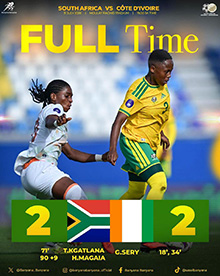
| Thembi Kgatlana scored the only goal of the game as Banyana Banyana booked their place in the quarterfinals of the Women's Africa Cup of Nations with a 1-0 victory against Burkina Faso in Casablanca. |
| |
Kgatlana’s close-range finish came in the 21st minute and was enough for Desiree Ellis' charges to seal a spot in the last-eight where they will take on host nation Morocco.
The South Africans went into the final Group B contest knowing they had to win after a disappointing start the continental campaign which saw them lose their opener to Ivory Coast then playing to a draw against Tanzania.
Banyana Banyana then also needed a favour from Ivory Coast against Tanzania, and they duly delivered with a 2-1 win to top the group with seven points, while South Africa qualified with four.
Banyana Banyana would have been on their nerves early in the second half when Burkina Faso were awarded a penalty as Antonia Maponya appeared to have brought down Adele Kabre in the box but the referee was sent to the monitor by VAR and the decision was overturned. |
|
|
| |
The South Africans really controlled the game after Kgatlana's opening strike and should have doubled their lead in the 54th minute but Isabella Ludwig failed to connect from her strike partner's square pass.
Burkina Faso threw everything at the South Africans in the final stages and looked dangerous with high balls into the box, but goalkeeper Kaylin Swart was solid between the sticks.
Ivory Coast 2-1 Tanzania
In the other Group B encounter, the Ivorians made sure they progressed as pool winners after a 2-1 victory against Tanzania.
Nsira Ouedraogo opened the scoring just before halftime and then the same player won a penalty early in the second half, which Ines Konan converted to double the lead.
Tanzania put up a late rally and pulled a goal back through Diana Msewa from a penalty late in the game, but it was too late to mount a comeback as the East African country were eliminated from the continental tournament.
Ivory Coast will take on Group A runner-up Algeria in the quarterfinals on Saturday.
– Source: www.sabcsport.com |
|
| |
|
| |
| 2027 ODI WORLD CUP IN AFRICA: ALL THE VENUES AND NEW FORMAT REVEALED |
|
| |
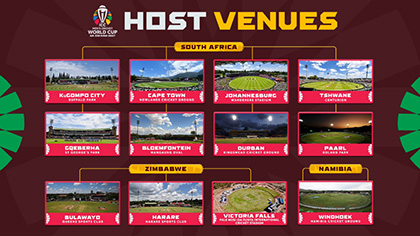
| Twelve venues across South Africa, Zimbabwe and Namibia have been announced as the hosts for the 50-overs 2027 men’s cricket World Cup next year. |
|
|
 |
|
| |
Eight cities in South Africa will host games, while three venues in Zimbabwe will welcome players and visitors, and Namibia’s capital Windhoek will also host matches.
The 12 host venues are:
- South Africa: Wanderers (Johannesburg), Centurion (Tshwane), Newlands (Cape Town), Kingsmead (Durban), St George’s Park (Gqeberha), Mangaung Oval (Bloemfontein), Boland Park (Paarl), Buffalo Park (KuGompo City, formerly known as East London)
- Zimbabwe: Harare Sports Club (Harare), Queens Sports Club (Bulawayo), Fale Mosi-oa-Tunya International Cricket Stadium (Victoria Falls)
- Namibia: Namibia Cricket Ground (Windhoek)
It will be the first men’s World Cup in Africa in 24 years, following the hosting by South Africa, Zimbabwe and Kenya in 2003.
Fourteen teams will be in action during the 2027 showpiece, which will feature 57 matches.
New format
A new three-stage format will also be in play for the first time.
An initial Super Series will see the three teams ranked from 12 to 14 play a round-robin format, with the winning team moving on to the next stage.
Then, a 30-match round will feature 12 teams, with the sides divided into two groups of six playing a round-robin format.
The top three teams from each group, along with the next best-placed team from both groups, will advance to the Super 7 stage.
The Super 7 stage will consist of 21 round-robin matches with the top four teams progressing to the semi-finals. The top-placed team will play the fourth-placed team, and the second-placed team will take on the third-placed team in the semi-finals.
The tournament will provisionally be held from 4 October to 21 November 2027.
– Source: www.citizen.co.za |
|
| |
|
| |
|
|
|
|
|
|
|
|